Thursday, 31 May 2018

Knightly Orders

I'm writing this for my wargaming project (which I'm tentatively calling The Dolorous Stroke in my own head), but it's loose at the moment. You can adapt it to other medieval settings, since basically it's a collection of weird chivalrous orders and why they go on quests and adventures. So, you get a nice set of motives for fighter/knight/cleric/cavalier/paladin PCs.

Here's the idea. The setting has knights divided into orders. Each Order is a distinct organisation with a few distinguishing features:
It's stronghold. This is a single geographic location where the Order is based. It could be a castle, a subterranean vault, a village, a cathedral. All sorts. This is where they meet, store their knowledge, get their equipment and salley forth from.
Its image of the True Knight. This is what they think a knight should aspire to. Basically the orders are all on a sort of quest for self-perfection but disagree over what that perfection looks like and how to achieve it.
Its Quests. Basically, what they do to become a True Knight. So the Order of Herne (who believe that a True Knight is one who has vanquished all monsters) quest to find ever more dangerous and exotic beasts to slay.

Its Insignia. This is how you recognize the Order. This could be heraldry (often an Order have something distinctive that appears on every knight's heraldry) but is just as often not. For example, the Order of the Wyrm don't wear a gauntlet on their right hand, to keep it free for spellcasting.

So you have various weirdos venturing out from their central stronghold to go on some personal quest that will make them a Better Knight, and of course their ideals won't match those they encounter most of the time. You have knights trying to slay wild beasts, to dig up the bones of dead heroes, to drink their foes blood, to get the most blinged-out gear ever, and so on.


Here are some of the Orders I'm ruminating on. Most are only loose ideas at this stage.

The Order of the Wyrm:
Magician-knights. Believe that the true goal of knighthood is power, and that magical knowledge is the surest root to it. They quest to find new grimoires and improve their arcane power. Their stronghold is a bleak black granite tower, filled with libraries of forbidden lore and fell spirits bound into the dungeons. Their insignia is a bare right hand, free of a gauntlet, with which to cast spells.

The Order of Herne:
Hunter-knights. Believe that a knight is measured by the monsters they have slain, and that the greater the foe defeated, the more noble the knight. They quest to hunt down and slay ever more mighty and exotic beasts. Their stronghold is a hunting lodge in the deep forest, and their insignia a pair of antlers mounted on their steed's brow.

The Order of the Red Maw:
Vampire-knights. Their esoteric order holds that nobility is a property of the blood (after all, aristocracy is hereditary; the right to rule is carried by blood). It stands to reason, therefore, that by taking on the blood of noble foes, the vampire can absorb that nobility into themselves. They quest to find and defeat the most worthy knights they can find, drinking their opponents' blood. Their stronghold is a deep underground vault, where the blood of every member of the order and every one of their defeated foes is poured into a huge well to be stored forever. Their insignia is a red stain to their armour.

The Order of the Unicorn:
Penitent-knights. They hold religion to be the most important ideal, and thus that the true knight is pious and holy. Their stronghold is a huge cathedral where the knights of this order pray, fast, flagellate and meditate, and their quests tend to be missions to protect nunneries, shrines and relics from danger. Their insignia is long reams of holy text pinned to their surcoat.

The Order of Golden Splendour:
Miser-knights. They believe that prosperity, opulence and luxury are the properties of a true knight, and thus that a knight should endeavor to be known for their vast wealth and the great works they achieve with it. Their stronghold is a beautiful manor surrounded by well-tended gardens, at the heart of which lies the Order's treasure vault, Their quests tend to be concerned with acquiring ever more wealth for their order, and their insignia is the gold trim on their armour.

The Order of the Black Lance:
Murder-knights. These knights believe that a knight's role is simple; they are a soldier, which is to say a killer of their fellow men. Thus, a true knight has only one defining characteristic, an immense talent for murder. Their methods are varied and dishonorable, and they are shunned by other orders for the unpredictable killings they commitThey have no true stronghold nor insignia, and are organised only loosely around a number of safehouses.

The Order of Thorn and Sting
Torturer-knights. They hold that the measure of a knight's worthiness is his ability to endure suffering. Thus, their quests tend to involve the knight taking on some horrible peril that will cause them pain and injury before they can prevail; when no such peril is available they train their fortitude by scourging one another's flesh with ever more inventive torments. Their stronghold is a dour fortress of grey stone and weather-beaten wood, lit from within by orange fires and with smoke pouring from its high chimneys. The insignia of the order is, inevitably, their many highly prominent scars.

The Order of Bones
Gravedigger-knights. They believe that an appreciation for their own mortality marks a knights true worth, and that whilst life is fleeting the legacies of the noble dead are eternal. These morbid knights study the bones of the dead, so as to gain a greater understanding of the forces of entropy and extinction that act upon all mortals. Their quests and studies are esoteric, and many step slightly outside of normal mortality, becoming living-dead revenants or sustained more by will than biology. Their stronghold is a great ossuary, and their insignia is a bone taken from this great mass grave as a reminder of their own impending death.

Tuesday, 29 May 2018

Arthurian Narrative Wargaming

Just a quick one.
I've been hacking together a set of wargame rules. The basic idea is that it's a narrative skirmish game in the style of GW's Inquisitor. Small groups of detailed characters engaged in action scenes. Freeform character creation, custom missions, playing with an eye towards RP and making a cool story rather than winning.
Setting is a sort of dark fairytale Arthurian thing. Inspiration coming from Warhammer Fantasy's Brettonians, tales of King Arthur, the stuff over at this amazing blog, and the more grounded sort of pseudo-historical fantasy. Each warband is a knight errant and their entourage, roaming the countryside, getting into scrapes, doing quests, duelling other knights and so on.

Mechanically, places I'm nicking ideas from include GW's Inquisitor, Malifaux, GW's lord of the rings skirmish game and ideas taken from tabletop RPGs such as various OSR games.


Things I'm doing with the rules:
Stats are rated 1-10, with 4-5 being about normal. Mostly roll-under to succeed, with the dice you roll varying depending on difficulty. So, to hit with a bow, you must roll under Accuracy on a d8 normally, but if it's raining perhaps that goes up to a d10.
Stats are: Speed (how far a model moves each turn), Accuracy (roll under to hit with bows etc), Prowess (roll a dice and add Prowess to see who wins a fight), Strength (roll a dice and add Strength to see if armour is penetrated), Toughness (this plus armour value is the target value you must beat in order to penetrate armour), Wits (used for awareness and initiative), Education (used for spellcasting, medics etc) and Charm (used for social stuff).
 Turn sequence is move phase (players alternate moving a model), Action phase (players alternate resolving models actions such as shooting, spells, healing etc), and then fights.
Fights are a roll-off to see who wins, like the LotR game, and then the winning side injures the losing side.

Injuries are handled in a way I'm really pleased with: Each character has a deck of cards with them, split into the four suits. Clubs is injuries, with the ace through to the king each representing a different wound like a gouged eye, pierced lung and so on. When the model is injured, draw a card from the deck and see if it's an injury the weapon in question can inflict (you can't impale somebody with a club). So the more dangerous weapons can inflict more of the different injuries, and so you're more likely to get a valid injury on the card you draw. If an injury is inflicted this way, the card gets put with the PCs character sheet as a reminder.
Blood loss is done with the Hearts suit. You start with all 13 hearts, and when you lose blood discard one or more, dying when none are left.

I'm setting up special combat rules for jousts, for sword-duels on foot and stuff. Special abilities for characters that will push them into certain fighting styles.
Magic that depletes willpower. The spades in a character's deck of cards are their willpower, and you discard them as your willpower is worn down by tests of your nerve and spellcasting.

It should be a sort of mix of old fashioned fairystories and legends and gritty fantasy. Questing knights jousting with elfin princes. Black-armoured vampire-knights and their retinues of skeletal thralls. Old hermit-knights uncovering the weapons of their youth to defend their shrines from ghostly marauders. Young nobles duelling in the midsummer sun over courtly romance.

I have no fucking clue what to call it, though. Suggestions?

Monday, 28 May 2018

VtM - New Koldunic Paths

I play a Tzimisce blood-sorcerer in an online Vampire: the Masquerade game, and I really like the style of magicthat kolduns use. Rather than the accademic hermetic magic of the Tremere or the morbid ceremony of the Cappadocians, a koldun directs the raw elemental power of the land they inhabit. Their magic tends to have a nature-ey feel to it, and is rough and brutal in application.
As ever, when I get keen about things, I write homebrew for them. So, here you have some: the ways of Wood and Blood.


The Way of Wood
This path utilizes the koldun's connection to the forests of their territory, controlling trees like a vampire with animalism controls wild beasts. A koldun with this power typically grows various trees around their haven to act as servants and sentinels. Many eschew wooden or stone buildings entirely, shaping their havens from the living forest.
To use each power, the koldun must spill their blood into the soil at the base of the tree, so that it soaks in and is absorbed by the tree's roots. 
Dice pool: Dexterity + Occult/Koldunism, with a difficulty of 3 plus the power's level.

Shape Wood
This power is the most fundamental of the Way of Wood, allowing the koldun to direct the tree's growth into whichever form they wish. This power is most commonly used with Accelerate Growth to rapidly produce plants of whichever shape the koldun wishes.
System: The roll allows the koldun to shape the tree's growth as they wish for as many 'stages' of its growth as the amount of successes achieved (see below for the specific details). The control is near perfect, producing any shape that could be produced through careful pruning, wiring, and trimming, and with none of the ugly scars. The tree can even be warped into distinctly unnatural shapes, far weirder than anything found in nature.

Accelerate growth
The koldun feeds a tree their blood, and it fills the plant with vigor, causing it to grow rapidly. This power is most commonly used with the preceding power to allow a young plant to grow overnight into whichever shapes the koldun wishes.

System: Each success on the activation roll advances the tree one 'stage of growth'. This growth takes a full day to complete; after twenty-four hours, the tree will have rapidly expanded to its new size. The stages of growth are:

  • Seedling (an inch or so)
  • Sprout (up to a foot)
  • Sapling (up to five feet)
  • New tree (up to ten feet)
  • Young tree (up to fifteen feet)
  • Adult tree (up to twenty feet)
  • Mature tree (up to thirty feet)
  • Old tree (up to forty feet)
  • Ancient tree (up to fifty feet)
  • Methuselah tree (sixty feet or more)

Awaken the Green Speech
This power awakens the slumbering mind within the tree, allowing it to communicate. The koldun interprets the creaks and groans of its limbs and the rustle of its leaves as readily as they would the speech of humans.
System: Each success on the activation roll awakens the tree's speech for one night, allowing the koldun to converse with it freely. The tree perceives everything that happens beneath its branches or above its roots, but its mind is strange: compared to humans, it is slow, sedentary and patient, considering most animals to be brief flickering things that appear and disappear without meaning or purpose.

Animate Huorns
This power causes the trees to move under the koldun's control, limbs bending and grasping like arms. Trees animated in this way are strange beings, but intensely loyal to the koldun; possibly the blood absorbed through their roots causes them to effectively become blood-bonded to the koldun.
System: Each casting of this power animates one tree into a huorn until the sun rises.
The huorn has as many health levels as their age category (so a seedling has one health level, all the way up to a Methuselah tree with ten), and the same amount of strength and willpower. Each success gives 1 dice to all attributes other than strength, and to the abilities Alertness, Athletics, Brawl, Dodge, Stealth and Throwing.
The huorn's thick bark grants it three dice of armor. Fire and axes deal aggravated damage to it, which it can only soak with its 'armor'. Everything else deals bashing damage, which can be soaked with its stamina + armor, if it affects the huorn at all (sunlight, cold and poison, for example, do nothing to a tree). The tree heals damage only very slowly, one health level per week of growth.
The huorn cannot move from the spot - its roots remain fixed in place - nor can it speak (unless Awaken the Green Speech has been used on it). 
The huorn is loyal to the koldun, obeying any instruction given absolutely. Absent of any instructions, it will fight to defend her and protect her territory as it sees fit. 

Strange Fruit
This final power invests the koldun's power into the trees they work it on; they feed the tree their blood and the tree absorbs it, storing it in bloated red-black fruit that swell from the underside of its branches. The koldun can pick the fruit to consume the sap-like blood within, or allow the tree to use it when animated as a huorn.
System: The koldun spends a willpower point and makes the activation roll; each success allows them to feed the tree one blood point. Each blood point the tree has ingested is stored in a single fruit. A tree can have up to three times it size category in fruit (from 3 for a seedling to 30 for a Methuselah).
A vampire that picks and feeds on the fruit gains a single blood point. The blood does not form blood bonds, nor can it be mystically linked back to the koldun who donated it, only to the tree from which it was picked. The sap within is thick, sticky and cloying, and the experience of feeding on fruit is likely very strange to kindred who normally only drink the blood of animal life. 
Alternatively, if the tree is animated as a huorn, it can spend the fruit like a vampire spends blood points, in order to increase its physical attributes or heal damage. Treat its generation as being the same as the koldun who animated it. In addition, it may spend a fruit to gain an additional action in combat (much like using celerity), but cannot make more actions in a round than its age category (so a maximum two actions for a sapling up to ten for a methuselah).

The Way of the Blood
The Way of the Blood functions much like the Way of the Spirit, allowing the koldun to spread their perception to those they have blood ties to; as their mastery grows, the koldun can extend their perception to those with ever less potent ties to the koldun. 
To use this power, the koldun rolls Appearance + Occult/Koldunism, with a difficulty of 4 plus the level of the power to be used. Each success allows the koldun extend their awareness for one hour.
When active, the koldun perceives not only through their own form but also through the forms of those they have an appropriate blood tie to. They simultaneously see, hear, smell, taste and feel all that those they are extending their awareness into do. Although they share perceptions, they are not directly affected by things their conduits are: exposing their conduit to fire does not provoke a frenzy roll, they cannot be dominated through their conduit's eyes, and tasting another's blood with a conduit's tongue does not blood bond them.
Furthermore, the koldun can cast other koldunic magic through any of the conduits as if they were there in person. The power is limited, however; they cannot use a koldunic power from another path at a rating higher than their rating in Way of the Blood (so, for example, they cannot use the fourth level of Way of Fire through a conduit if they only have three levels in Way of the Blood). 
Finally, whilst the power is active, any individual who becomes blood bonded to the conduit becomes likewise bonded to the koldun themself.
Even when the power is not active, the koldun instinctively knows if an individual is a conduit to any levels they possess. 
The conduits allowed at each level of Way of the Blood are as follows. Each level also includes those of the level above it.
  1. The koldun's childer, and any vampires directly descended from those childer (their grandchilde, great grandchilde etc).
  2. The koldun's ghouls (IE any ghouls at all blood bonded to the koldun).
  3. Any mortals (human or animal) with any level of blood bond to the koldun.
  4. Any vampires directly blood bonded to the koldun (or with a vinculum to the koldun).
  5. Any ghoul or mortal blood bonded to a vampire conduit from the previous levels.


Paradox Beasts for Esoteric Enterprises.


Paradox Beasts are the various beings brought into existence when magic goes dangerously wrong. It’s unclear if they’re created by the magic itself, intruders from other realms of existence, or formed by reality as scar tissue against the damage done. What is clear, however, is that they are dangerous.
Where a paradox beast exists, the basic structure of reality is altered. Causality becomes more shaky, the laws of nature don’t quite apply in the same way. If allowed to remain, their influence will grow, infecting ever greater areas around them with their contagious unreality.
Each paradox beast is unique, and most utterly bizarre in appearance, but there are common motifs. Most are biological-looking, resembling alien life-forms. Often, their anatomy is nonsensical, and outside the aura of altered reality they create their biology wouldn’t be able to sustain life.
It’s impossible to say if they’re intelligent like we are. They don’t talk, and don’t really seem to have tools of their own, and seem to be struggling to cope with the world they find themselves in. It seems that mundane reality is as alien and confusing to them as they are to normal humans. Most go on a blind, baffled rampage on arrival in the real world, unable to properly comprehend what’s going on. A rare few survive, hide and grow used to the world they’re in. They warp the environment around them and grow old and cunning. Perhaps many of the true horrors of the deep earth were once paradox beasts, now acclimatized to this world. Perhaps they have plans that even now are being brought into fruition.
The appearance of a paradox beast is likely to attract the attention of Men In Black and other authorities, who will deal with the outbreak with brutal efficiency. Witnesses are mind-wiped, evidence destroyed. They aren’t demons or devils, but to an ignorant civilian they might as well be.
They shouldn’t exist. Every fibre of your being tells you that.

Creating a Paradox Beast
The first step is to determine how many Hit Dice the paradox beast has. Normally, the total number will be determined by the effect that brought the beast into existence. Otherwise, roll a d12 for it.
Of these hit-dice, some will be flesh and some will be grit. Roll a d10; this is how many dice are flesh dice, the rest are grit. If the result is more than the creature’s total number of hit-dice, then instead the creature has two flesh dice, and the remainder grit. (Obviously, a creature with only one hit dice only has that one dice of flesh). The number of flesh dice the creature has determines it’s size, according to the table below.
The Paradox Beast’s AC has a default value of 12. Its saves are determined by it’s total number of hit-dice, as seen on table XX.
Assuming it doesn’t have any other attacks granted by its features, a paradox beasts attacks once. The to-hit bonus is equal to its number of hit-dice, and the damage depends on its hit-dice, as shown on table XX.
All paradox beasts have certain strengths and weaknesses. If they enter an anti-magic field or similar area where magic is suppressed, they blink out of existence for as long as the field of Antimagic remains in place. If they are hit by Dispel Magic or similar spells, that deals d12 damage to them.

Paradox Beast Forms, Features, and Effects
Each paradox beast has a particular shape that its body takes. Roll a pair of d20s on table XX overleaf to determine what the beast’s basic form is; the first determines the basic shape, and the second gives an adjective that modifies it. The creature’s form and adjectives may modify its basic stats.
After this, determine the paradox beast’s features. These are the unusual organs or special abilities that the creature has.  Roll a few d20s on table XX to generate them. At least one, maybe as many as six. Keep rolling until you’ve got a satisfying amount. If you want to go fully-random with it, roll d6 features.
Lastly, each paradox beast has effects; the way they warp the world around them. Like with features, roll a d20 on table XX to determine what their effect is. Keep rolling until you feel you’ve got a good selection, or just roll up d6 effects.


And there you go. Paradox beasts for Esoteric Enterprises, since they aren't in the player book. Have fun!

Thursday, 24 May 2018

Esoteric Enterprises now available

I made this cool thing.

So, book 1 for Esoteric Enterprises is done and up for sale. In this post, I'll talk about it a bit, and post some screenshots from the PDF.
First up, here's the (still WIP since I'm fiddling with the print stuff) front cover.

So, the game is basically built around the same engine as WP&WS. Built around a skeleton of LotFP and B/X, with the various houserules I apply in basically all my games. So, Flesh & Grit for hitpoints, ability modifiers apply to your skill rolls, everybody gets access to fighting agressively/defensively, experimental spellcasting, mystics (who roll for prayers rather than memorizing spells) instead of clerics, etc etc. If you're familiar wth WP&WS, this will be very familiar to you, if you're familiar with LotFP and other OSR games, still pretty familiar.

Classes (and their more familiar equivalents) are:

  • The Mercenary. Basically your Fighter. Gets slightly better gear, bonuses to hit, and better use of combat maneuvers.
  • The Bodyguard. Basically your Dwarf. Hard as fuck to kill, decent in a fight, and has an improved chance to notice stuff. Tough as BALLS.
  • The Criminal. Basically a Thief, but closer to LotFP's specialist since skills are 1-in-6 that it then puts points in. Skills available are athletics (for fleeing, climbing, jumping etc), Charm (lies, bribes, intimidation and disguise), Contacts ("I know a guy who can sell us that!"), Drive (for car chases), Forensics (follow tracks, examine corpses, that sort of thing), Medicine (give back HP, diagnose stuff, etc), Perception (avoiding ambushes and maybe traps), Stealth (avoid being noticed), Technology (Macguyver stuff, hack computers, etc), Translation (do I speak that language? Can I crack that code? Can I read that spellbook safely?) and Vandalism (busting down doors with crowbars or possibly dynamite). 
  • The Explorer. Basically a halfling. Not great at combat, amazing saving throws, sneaky and athletic. These guys are fluffed as urban explorers; kids who just want to see what's out there in the dangerous forgotten bits of the city.
  • The Doctor. Pretty much Franken-Fran; the class. Loosely (very loosely) based on the cleric: it gives back HP and does Mad Science like brain-swaps and grafting in the fire glands from a dragon. I fuckin' love playing mad doctors.
  • The Occultist. A classic MU. Spellbooks, spell slots/level, the works. Can cast experimental magic, at risk of causing weird magic backlash, but pretty safe as long as they cast normal vancian spells.
  • The Mystic. A cultist loosely modelled on the cleric. Uses the same spell-list as the Occultist, but casts differently. When you try to cast a spell, roll Charm to see how much your God loves you. On a pass, you cast, on a fail, the deity meddles in your affairs. Maybe you need to offer a sacrifice, maybe there's a weird restriction placed on you, maybe you black out and have holy visions.
  • The Spook. Very loosely based on the elf. Covers all your non-human (or slightly human) PCs: vampires and redcaps and wendigos and golems and the wandering souls of coma patients and jorogumo and more. Rather than spells, they get always-active powers: stuff like a bite attack, or the ability to talk to animals, or to mimic voices, or iron-hard skin, or unearthly beauty. Kind of a toolbox class to cover any weird concepts you might have.


But, it's updated for a modern day setting. So, the saves go from paralysis/poison/breath/wands/magic to stunning/poison/hazards/machines/magic. Stunning is used for a lot of stuff like electric shocks, and machines is a save vs traps, technology and so on.
There's rules for guns. Guns are actually pretty simple in this: long range, roll to hit as normal, high damage dice (d12 for a shotgun!). A roll of 1 to hit means you're out of ammo and need to reload. It's really all you need, to be honest.
The most interesting tactical stuff in a gunfight comes from the suppressing fire option in combat. Rather than making a roll to hit on your action, you declare which area you're shooting at and get to make a roll to hit on the enemy's action if they make themselves vulnerable; if multiple enemies make themselves vulnerable, you can make multiple shots. (Anybody can do this with an automatic weapon, but the combat specialists - mercenaries and bodyguards - get to do it with basically any gun). Combine this with cover giving massive bonuses to AC, and you get fights where both sides are hunkered in cover and need to find ways to flush the other side out. Grenades, magic, flanking maneuvers etc etc come into play here. It's streamlined but produces cool tactical situations.

Oh, I made the horrible wounds from the back of WP&WS core in this. Because I like them, and 'you die at 0HP' is fucking trivial to houserule in so if you don't like it the fix is easy. Hell, the game outright states that the wounds are just for PCs and monsters die on 0hp, so its right there even if you're dumb.

Other stuff you have covered are things like hacking computers, disguising yourself, going to the hospital, finding a guy to fence your loot, etc.

Loot is where you get your XP from. You get XP by:

  • Looting valuable stuff (cash, magic items, works of art, historical treasures, shipments of drugs) from somewhere occulty and dangerous.
  • Getting paid protection money by members of the underworld, or getting paid reward for doing missions.

And nothing else. So a PC who has leveled up has, by necessity, made a fuckton of money doing so. As a result of this, I've scrapped tracking money for every purchase and assume that, the higher your level, the richer you are and the better your life is. The resources available to you are based of your character level, and set what you can afford to buy: for anything expensive, you roll under your resources level to see if you can scrape together the cash to afford it. More important is finding somebody willing to sell you whatever it is you want on the black market: this is where the Contacts skill comes in.


Magic is in the rough vein of the LotFP and WP&WS model: weird cosmic shit that mortals are meddling in. Classic spells like fireball and invisibility are in, but stranger stuff is also in, like a spell that makes all technology nearby fail, or one that transports the victim into the future, making them a problem for tomorrow.
There's a bunch of tables for magic; things that happen when you fuck up, mostly. I fucking love magical fuckup tables, they can push events forward, inflict things on PCs that make them feel unique and produce those OH SHIT HAHA WOW moments that I like. Different fuckups have different tables, so translating a scroll wrong has a different table to failing to please your god.
Occultists can (with some work) make scrolls to cast from, and Mystics can pass their spells on to the faithful as blessings, so both classes get to share the love somewhat.
There isn't much of a concrete setting in the book: a few pages in the front explaining what the Occult Underground is, who the Men in Black are, what Paradox Beasts are. The rest is all implied. You get mentions of various supernatural factions like the Lithic Courts (from the deep underground) and the authors of various grimoires. And then, with the tables in the back about coming up with character backgrounds, you can probably deduce a lot of the feel of the world just from that.
Really, this game is just me mashing my two big loves in gaming - oldschool D&D and World of Darkness - into one package. So its a game where broods of vampires wage a hidden war with mexican drug cartels, where boneless goblin-things squirm through the sewers hunting vagrants and drunks, and where cultists of Ithaqua meet in abandonned buildings to offer sacrifices to appease their horrible god.
I've written before about how, to me at least, D&D PCs should be scummy semi-criminal social outcasts. How Adventurers are the desperate types on the fringes of society. This game is pretty explicit about that. If you're a PC, it's because you're a weapon smuggler or a cultist of something the authorities have proscribed or a flesh-eating undead monster or just kind of a drugged up social dropout.

I'm pleased with it. It's by no means perfect (I am both terrible at spelling and can't be assed to hire a proofreader, and my budget for art was literally £0.00) but it's come out fine.
I'm hoping that the atmosphere comes across nicely. It's a game about scummy weirdos fighting nasty monsters in the sewers, so they can hijack a shipment of cocaine and occult grimoires. It's a blend of gangsta rap and black metal and weed and the occult and mafia films and lovecraft. The Black Goat In The Woods With A Thousand Young mashed up against inner-city gangs peddling coke.
All the shit your mum was worried that this D&D stuff would get you into. All that scary music your parents disapprove of. Like, I don't wanna be too edgy with it, but a game where you get gunned down by the police for sacrificing kids to an Aboleth is a good game IMHO.
This is book 1, with the game rules and stuff in it. All you need in order to play. Book 2 is still WiP, but will be for the ref. This one has monster/NPC stats, systems for handling the too-and-fro of the underworld politics, guides to building locations, all that jazz. It will probably have a bunch more stuff on the implied setting: nothing concrete, but a lot of ideas to spark the imagination.
I'll put it up when its done. In the mean time, stuff that I think is cool or useful enough will go on this blog.

It's on sale here. You should totally buy it, it's 5 bucks for 90 pages and I think it's good.

Friday, 18 May 2018

=]|[= GW's Inquisitor as inspiration =]|[=

In which I talk about the best thing Games Workshop ever made, how it was totally underappreciated, and how to apply some of its ideas to oldschool RPGs.

When I was a kid, I was into Warhammer, which was cool, with its big armies of goblins and skeletons and stuff. However, right about the time I was 12, Games Workshop released Inquisitor. 
And Inquisitor, as a game (and particularly for GW) was weird.
To start with, rather than the big armies GW was known for, it was a tiny skirmish (smaller even than something like Mordheim or Necromunda), with 2-5 54mm figures on a side. These figures were unique; you didn't get a generic soldier or anything. Instead, the book gave you a bunch of setting details and then told you to come up with something cool for your characters and stat them yourself, with only a few guidelines on how to do that. And then to convert your own figures; using the miniatures out-of-the-box was rather looked down on.
The basic expectation of play was that you had a GM, and one or more players with their little warband of an imperial inquisitor and his followers, and you'd play through a custom narrative scenario to see what would happen. The game's text was pretty explicit that the point was not to win but to create a cool story from the game. You had characters doing things like disarming bombs, trying to get all the parts to summon a demon... hell White Dwarf literally published a battle report that was mostly both sides talking like adults (well, until an angry third party showed up with a chainsaw).
Oh, and the rules had a bunch of cool stuff with things like realistic injuries, psychological stats, dangerous psychics and so on. But they're less important here.
It's an interesting approach. Don't bother balancing things or trying to make character creation 'fair', just trust the players not to be dickheads and to pick interesting things rather than game-breaking things. Knowing GW's standard model (points allowances and competitive games), their playerbase didn't really know what to make of it. It got a cult following, but GW stopped supporting it after about half a decade.

I really liked it. I'd been into wargaming for a few years already. Inquisitor came into my life at about the same time D&D 3rd edition did, and I'd not really encountered RPGs before then. However, while 3rd kinda turned me off with the vast amounts of prescriptive mechanics and requirements and prerequisites getting in the way of the fun stuff... Inquisitor captured my imagination. Here's the setting. Make something cool. We trust you not to be a dick about it.


So.
What if we took that approach to RPGs? I've read a bunch of games, ranging from the avowedly old-school (I blog about OSR stuff mostly), to the weighty tomes of Vamp and its ilk, to the weird experimental art games like The Mountain Witch and Monsterhearts and so on.
All of them - all of them - have mechanics for character creation. Even in the 'pass the talking stick' story-focussed hippy games, all of the ones I've played require you to fit your character concept into the mechanical constraints of the character gen procedure.
What if this wasn't the case?

Here's how you work it. I will be using OSR games for my examples here, but you can apply it just as well to other games, too.

Character gen works like this:
  • You come up with a character concept.
  • You read the rulebook, look at what a starting PC might have, what they get as they level up, etc. What different monsters get. How it all fits together.
  • You then choose all of your stats. Set your six attributes, Hit-dice, saves, class abilities to what you think is appropriate. No restrictions. Think your barbarian princess should have charisma and strength both at 18? Fucking go for it. Want to have a wizard with a spellbook who casts mostly cleric spells? Go for it. Want Turn Undead and Thief skills on your vampire-slayer? Go for it. 
  • So long as your character is mechanically viable (IE you've not forgotten to give her, like, hit-points or something), you can write that. It doesn't need to obey the rules of normal chargen. Give them what matches your concept, just like the GM does when designing a monster or NPC. Hell, make up abilities if there's nothing in the rules modeling what you want already.

You do all of this alongside your other players and the GM, you bounce ideas off each other and check in to make sure nobody's PC is vastly stronger/weaker than anybody else's. I'd say level 2-5 is probably your sweet spot for power. Don't worry too much about balance though. 
Make characters with strengths and weaknesses and exploitable flaws and potential. Give them an interesting playstyle. Be the amateur game designer you always wanted to be.

So, how is this balanced? There are three things to bear in mind here:
1) you are not trying to win, you're trying to create an interesting character.
2) nobody has to play with you if you're a powergaming dick.
3) if you are being a powergaming dick, then the GM (and to a lesser extent the other players) need to solve that as a social thing by talking about expections like fucking adults.
Like, obviously this is a thing you do if you're all on the same page. If you are playing with somebody who will willfully go against the social contract of the game so they get to feel they 'win' a non-competitive venture, that person is an asshole. Why are you playing with them?

So that's character gen. Now, in play things work basically the same. Follow the normal procedures and methods that you normally would, with a few exceptions.
Find a fun Death & Dismemberment/Critical Wound/Injury table, or something. I put a fun one in WP&WS, I'm putting another fun one in Esoteric Enterprises. WHFRP and the 40kRPGs have some pretty great ones too. Hack the game so that taking damage (or taking enough) damage inflicts a relevant wound on you. Off the top of my head 'any damage roll that does more than [the max on your Hit Die] also inflicts a Wound on you' works.
You do not earn XP. You only advance by Doing Tangible Stuff in game. In D&D, the fighter finds a magic sword, the wizard loots a spellbook, the cleric makes dark pacts with horrible inhuman things they encounter for more spells (if your cleric isn't a boggle-eyed cultist loony worshipping something creepy, it is boring and I will judge you). Maybe you drink from a magic fountain for +1 wisdom. Maybe you eat the heart of a dragon and it grants you DRAGON BLOOD (whatever that does). In vampire the masquerade, there is already a wonderful mechanic for this called Diablarie; playing a sabbat pack who's only mechanical advancement is by diablerizing their enemies would be cool as fuck.
Basically, events in world can make your character weaker or stronger based on what happens to them, but it's in response to specific events; there isn't the expectation that you'll gain levels.
(I have, incidentally, played in a 6-year-long Larp that used that method of character advancement: the only way to get stronger than the standard mortal you started out as was by getting blessed by the gods or doing magic experiments on yourself or being turned into a monster. No XP. No expectation of advancement except for what you did in world. It worked brilliantly).


So, why play this way? A few reasons:
  • I fucking HATE character gen minigames. Like I've gotten really good at bending the oWoD character gen to let me make a specific concept, but fuck it. Let's just write up the stats for what we want to play as, this isn't a fucking competitive venture and even if it was the balance provided by character gen rules is always laughably terrible. 
  • Getting Cool Stuff feels more special. When you're on the mechanical treadmill of constantly gaining XP and new NUMBERS or ABILITIES it looses its luster fast. Sometimes, having to earn improvements feels that much more satisfying. (This feels to me like you have a 'automatic vs earned advancement' scale with XP-for-showing-up-to-the-session at one end, and XP-for-Gold like OSR stuff uses towards the other. And then this is even further on the 'earn your shit' end than XP-for-gold even).
  • You get to just play what you want without needing to give a shit about 'but to get more NUMBERS I need this' which an XP system looms over you. So there's an immersion benefit.
  • The design space for this is TOTALLY UNEXPLORED. Like, maybe one of the pass-the-talking-stick games does this, but playing something fairly traditional like D&D or WoD this way? I've never seen it written about.
  • Honestly, GW went out on a limb with Inquisitor and did something weird and arty and experimental. Let me reiterate that. Games-fucking-money-grubbing-Workshop went out on a limb to do something weird and experimental. And the ideas in it never really went anywhere because there's a prevailing consensus that of course RPGs have restrictions on character gen and advancement and you can't trust PCs not to be munchkins you have to constrain them for their own good and FUCK THAT Inquisitor deserved to be way more influential and critically recognised than it was.
And, yeah. I've never actually played this. It's just a thought experiment that I might institute when I next run a game or I might not (because fiddling with what gives XP as a way to shape PC personalities is a favourite mechanic of mine). Let me know what you think.

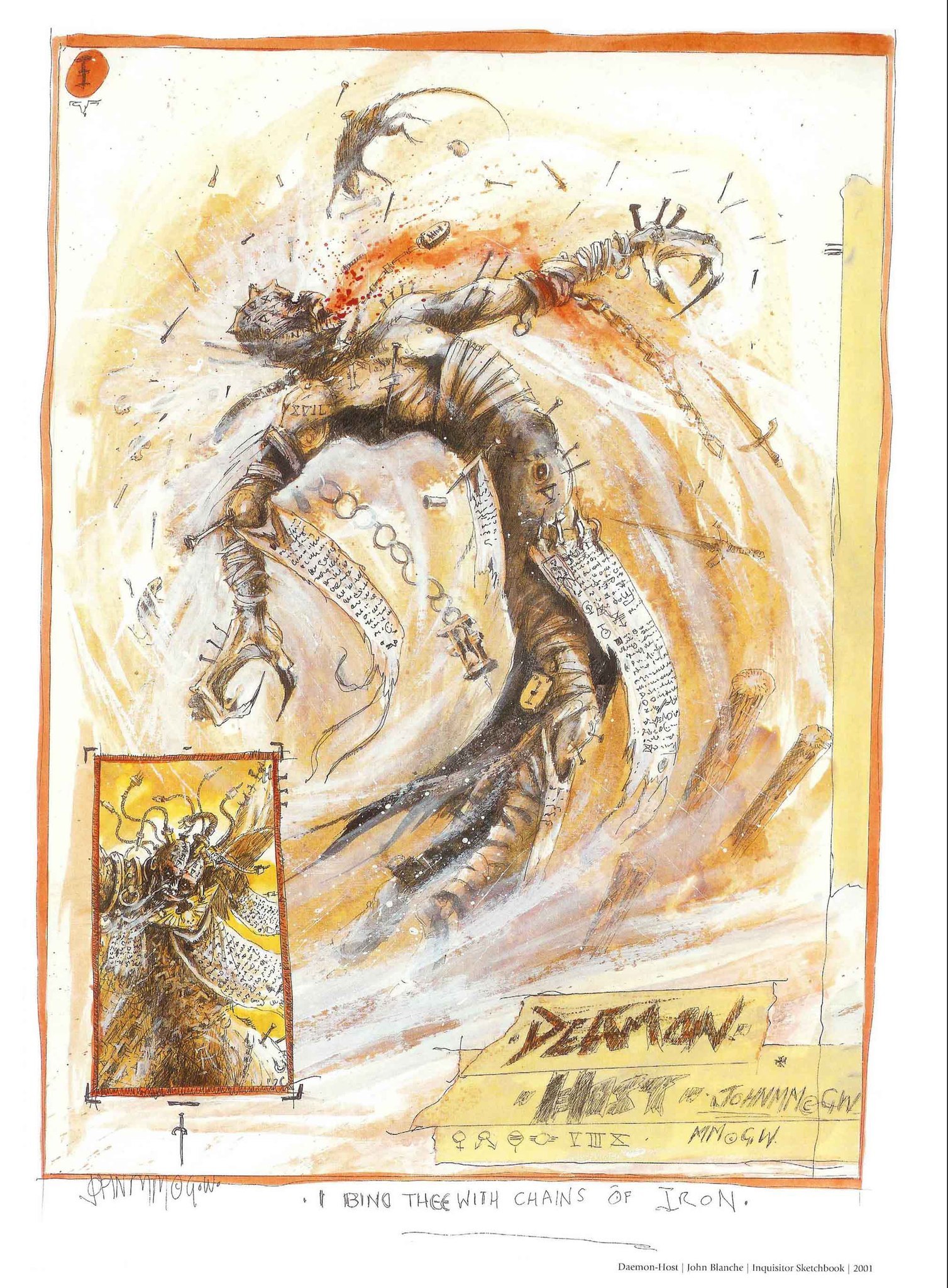
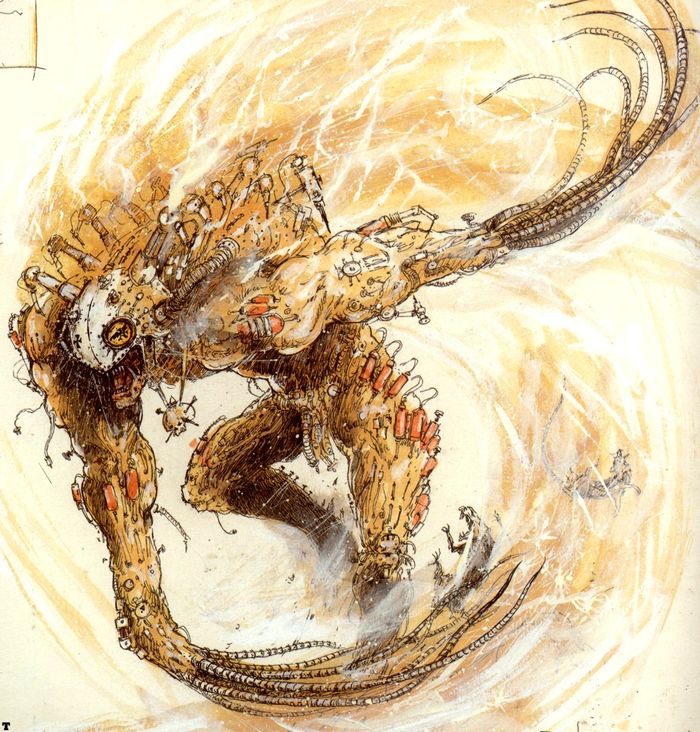
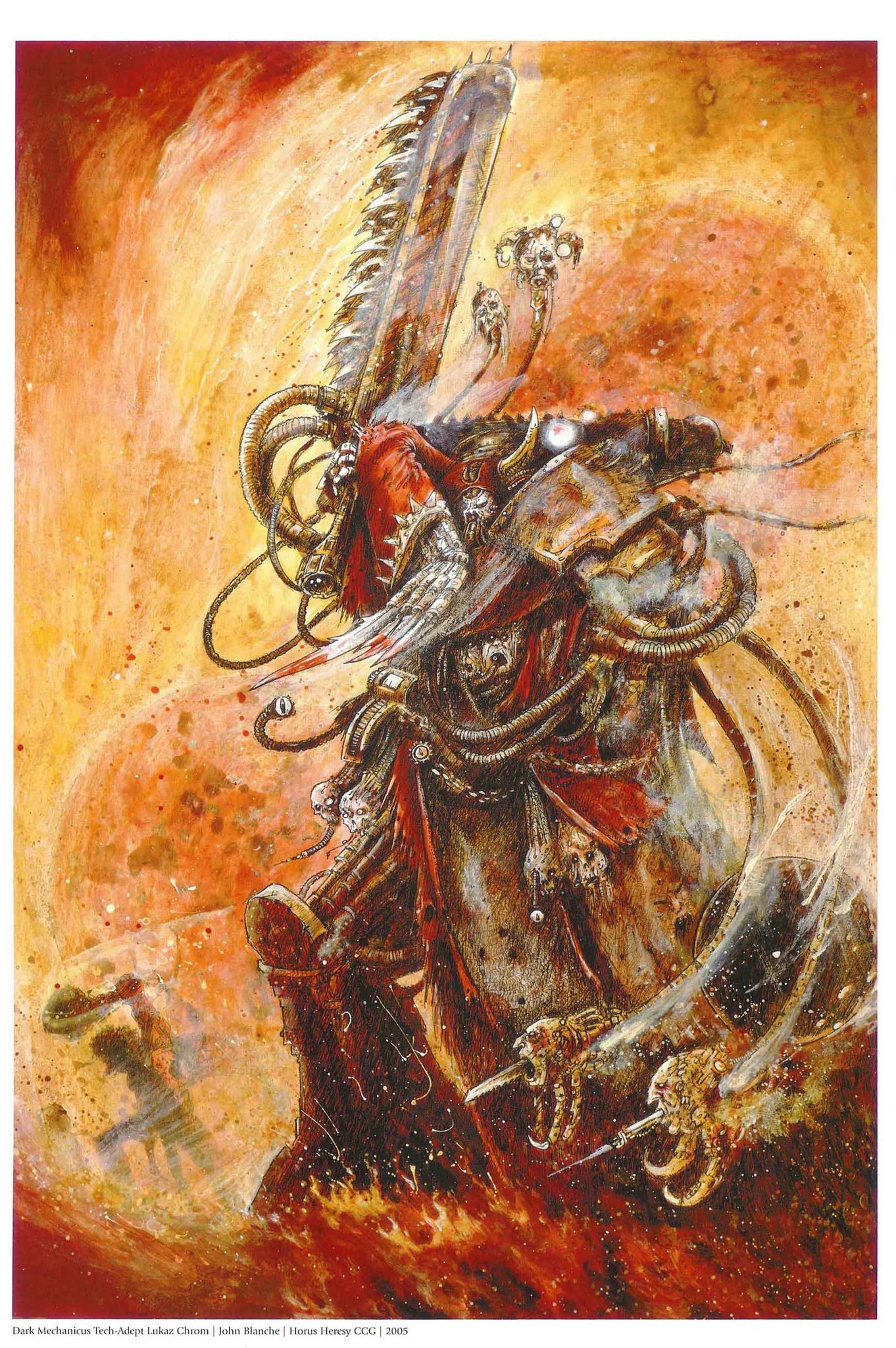
Also some of the art for Inquisitor was fucking badass. Look at this shit.

Fuck I loved this game an unreasonable amount.


Wednesday, 16 May 2018

Esoteric Enterprises visual stuff

In which I talk in a vague sort of way about making my next book look pretty.

One of the early decisions I made was to try to give the book a fairly distinct color palette. Specifically, a sort of grungy high-saturation-low-contrast green and purple. Like the tint to old photos. It's a palette that I always associated with marijuana (from the purplish lights shining on green leaves when its grown), which seems appropriate, and it pops up in the colouration for a decent amount of stoner metal albu covers. The coloration is fairly distinct, I think. Most RPGs go for black & white (if they're going for a gothic look, or a strong inked style), or a sort of faded sepia parchment tone (to look like old books), or blues and greys (all modern and scifi). Its a bit psychadelic and odd.

Here's an example of the palette that I'm using for chapter headings. Similar images are used for the section markers going down the side of the page, for the page numbers and so on, all using the same textures.


This also gives a good example of the sort of grungy texture I want: the edges look ripped and ragged rather than being smooth straight lines.

The art I'm using is all photographs (all creative commons, because I'm poor). For a modern setting with the conceit that it's the real world with hidden magic, I think this works. The images give things a more immediate feel, which then feels a little more surreal due to the purple-green filter applied over the top.  It should help make things feel like the real world gone strange, rather than a fantasy world. Here's some photos.


Other than that, I'm going for a fairly simple look. Black text, white backgrounds. Two-columns, no page border. Tables are white text on black backgrounds, mirroring the white text on dark backgrounds in the tittle bars. Fairly minimal.
I'm putting a bar on the side of the page that gives you which section you're in, so when you flick through the pages it's easy to find where you are. Trying to be careful to keep most sections of information on a single two-page spread where possible, to avoid page-turns in the middle of reading.
It ends up looking like this:
Which I'm OK with. It's not particularly flashy or exciting like some of the work out there. But then, I'm working with free software and public-domain photos, so it will do. I figure that so long as I don't look totally zero budget I'm good (I mean, I am going with £0.00 budget here, but there's no need to advertise that).


Some other thoughts, in no particular order:
  • Black Metal gigs are a great source of images of vaguelly occulty looking weirdos. All you need to do is 'shop out the musical accoutremants, and you're good.
  • It's really hard to find interesting public domain photos that aren't of regular-looking white dudes. 
  • There's a wonderful variety of photos of sewers, tunnels and other underground spaces out there. Urban Exploration looks far more popular than I'd expected, and some of the weird eerie photos they've produced have been a big influence.
  • Most photos of 'monsters' and so on are either zombie walks or of people dressed as the Krampus and similar folklore-ey figures.
  • Public domain pictures of people waving guns around are surprisingly rare.
  • There's far less gore and nastiness out there than I'd hoped for. Which sucks for me doing layout, but is probably comforting if I look at the big picture.