Friday, 17 January 2020

Hacking EE Campaigns

So. Esoteric Enterprises is out and seems to be quite popular. I've seen a few different people discussing ways they'd run the game that isn't the 'you're a gang of criminals and meddling idiots' default, and this is very cool.
Anyway, I am 100% in favour of hacking games to make them your own, so here's a few ideas for games I might run.

For more heroic, bloodthirsty or exploration-based games, here are some XP hacks that should work quite well.

By and large, you can make a game that focusses on a particular style of monster (the same way - for example - various WoD games do) by simply tacking on the perks and drawbacks of an appropriate Spook Origin and any Monstrous Powers onto all PCs. Spook PCs are just those monsters that choose to focus on developing their inner power, rather than learning more general skills or pursuing unrelated magical power.
Some example monsters:
  • Werewolves: Living origin. Achilles Heel (silver). Animal Shape, War Form, Animal Speech, Bite.
  • Standard Vampires: Undead origin (or living, perhaps). Blood Drinking. Creature of the Night. Bite Attack.
  • Clan Tzimisce: Undead origin. Achilles Heel (sunlight). Blood Drinking. Pick three from: Flesh Sculptor, Animal Speech, See the Unseen, War Form, Hypnotic, Intoxicating Blood.. Metamorphosists use the Spook class. Fleshcrafting weirdos use the doctor class. Kolduns use the Mystic class (with Kupala as their patron). Old Clan are mostly mercenaries or explorers.
  • Ghosts: the Ghostly origin (obviously) and maybe ALSO the undead origin. Everybody gets 1 spook power to let them touch physical objects (shadow tentacles, invisible hand or poltergeist, probably). 
  • Cute Zombies: Undead origin. Detach Body Parts, Achilles Heel (headshots), Painless.
  • The Lithic Courts: Mineral Origin. Everybody starts at level six, and gets: Immune to Fire. Huge Size. Whichever one gives you bonus AC I forget the name. Unnatural Strength. Painless. Tremorsense. The Lithics are fucking hardcore
  • Morlocks: Living origin. Darkvision, and pick two from Smell Magic, Magical Prodigy, Spell Warper, Spider Climbing. Can take spells tattooed into their skin at character gen (treat them like a magician buying starting grimoires) that they can then make scrolls of. Normal morlocks must be mundane classes (bodyguards, criminals, explorers, mercenaries) while Eloi are instead Undead, and must be Occultists.
  • Innesmouth People: Living origin. Aquatic. All in the cult of the Leviathan. 
Obviously, if you're doing this, all the PCs need to be the same sort of monster, or else any semblance of balance goes straight out of the window.


Monster Hunters
The world is full of inhuman predators, infiltrating society and feeding on normal humans. Like you. Your friends. Your co-workers. Your family. You've seen them. You went to the police, and they told you not to push things further, and made it very clear that doing so would attract the wrong sort of attention to you. The establishment is riddled with things that look like people, manipulate people, but aren't people - not really. The only people you can trust are those who, like you, have seen the rot lurking within society and survived.
Inspiration: Hunter the Vigil, Call of Cthulhu, Buffy.
Classes: Mundane classes only (Bodyguard, Criminal, Explorer, Mercenary and maybe Doctor).
XP: Half XP for treasure, and only when it's liberated from supernatural monsters. Killing a supernatural monster is worth 100 XP per HD, plus 100 XP more for each victim you know (or are pretty sure) it's killed.
Rules variations: You start out at -10 reputation for every faction. 
Enemies: Monsters such as vampires, fairies, werewolves, the living dead. Worse things. Things that prey on humans. Make it graphic. Make it nasty.

Supernatural Revolutionaries
Magic is the true legacy of humanity. The world has been taken over by a sinister cabal, the Men in Black, who seek to snuff out this transcendent destiny, to keep us living like beasts in the dirt. They control everything, infiltrate all levels of power. They must be overthrown. The uprising begins at home, with you. Grab a molotov and make a difference.
Inspiration: The French resistance, Mage the Ascension, Black Crusade
Classes: Any, but supernatural classes (spooks, mystics and occultists) are particularly favoured.
XP: XP only for damage to the Men in Black and their operations. Every Man In Black you kill is worth 1,000 XP. Every £ of damage you deal to Men-in-Black facilities is worth that many XP (IE, blow up a MiB laboratory that will cost them £50,000 to replace, and that's worth 50,000 XP. Every supernatural being or aware human you rescue from MiB custody is worth 1,000 XP.
Rules variations: None. 
Enemies: The Men in Black, and mundane law enforcement. The weight of societal conformity. 

The Cult
You know the truth. Below the city, there lurks a true divinity. You see it in your dreams. It speaks to you. Shows you the beautiful world it will create when it's free. Shows you your place in the world that is to come. You understand it, know that your fellow humans don't comprehend its full majesty. You must work in secret. Your master has tasks for you, so that it might be freed. The day of reckoning draws closer. Soon, all of this will have been worth it.
Inspiration: Call of Cthulhu, various sorts of religious horror, Black Crusade (again)
Classes: Any, but mystics are particularly favoured. All mystics must worship the same patron, and non-mystics will be of this patron's cult.
XP: XP for treasure replaced with XP for treasure if it's offered to the divinity as sacrifice. Completing a task set by your patron is worth XP: GM's discretion, but a task appropriate for the PCs level, taking about a month to complete, should be about enough to level up once. Less for easier tasks, more for harder ones.
Rules variations: The city's faction-map always includes a Sleeping Godling - the cult's patron - who the PCs start at +10 reputation with. All PCs get the ability to contact the divinity in their dreams: this is mostly religiously-affirming but not mechanically significant. However, they can ask the Divinity for instructions before sleeping, and if they do the divinity will communicate in pretty direct terms what it wants. The XP reward for this is a non-diegetic abstraction, but PCs get a sense of how much the deity wants this (IE, how much XP you'll get). 
Enemies: Rival cults (all heretics). Law enforcement. Anybody your god tells you is an enemy.

Vampire Broods
You woke up one night with the salt-iron taste of blood on your lips. The sun burns you now, food turns to ash in your mouth, your heart beats only reluctantly. And the thirst... it overwhelms you at times. There are others like you. Your paths cross as you search for prey, you decide to cooperate. You hold each other back from becoming truly monstrous. You avoid the attention of beings that long ago abandoned any semblance of moral restraint. You know, deep down inside, that a similar fate awaits you unless somebody puts a bullet in your head first.
Inspiration: 30 Days Of Night, Vampire the Masquerade, Let The Right One In.
Classes: Any except Spooks. All PCs gain the perks and drawbacks of being an Undead spook, as well as the following Monstrous Powers: Blood Drinker, Bite Attack, Achilles Heel (sunlight).
XP: XP for treasure at 1/10th the normal rate. Killing a mundane mortal by draining them of blood purely for the joy of feeding grants 1,000 XP. If it's somebody you have known by name for at least a year, you immediately gain a new monstrous power exactly like a spook who just levelled up.
Rules variations: Each PC must drink at least a mouthful of human blood each night, or else be Fatigued until they next drink. Each PC keeps a tally of the number of  mortals they've killed (whether or not they drunk from them, and count those they've known by name for at least a year as 5 such people). When it reaches 25, the PC only gains XP for killing mortals. When it reaches 50, they get a 'debt' of 100 XP each night they don't drink. When it reaches 75, they must Save vs Stunning to avoid drinking if they have a chance to do so without being caught. When it reaches 100, the character becomes overcome with bloodlust, and goes totally feral, becoming an NPC; their first action will be to try to devour their fellows.
Enemies: Mortal vampire-hunters. Victims, some of them not totally helpless. And, worse, the things that your kind become after too long.

Agents of the Dero
You see them at every turn. Signs of their influence. It's all one big conspiracy. They're trying to control your mind. But, you can turn their tools against them! Manipulate the perception of reality, and reality shifts to match it! Warp reality to foil their schemes. You know others like you. Between you, you can put together the truth. (Words are tricky: does put together mean work it out? Or does it mean build your own truth from fragmentary parts?) 
Inspiration: Scanners, Jacob's Ladder, Lacuna, Don't Rest Your Head, the writings of Richard Sharpe Shaver.
Classes: Human agents can be any class except mystics or occultists (but Spooks must have the Human origin, and are basically latent psychics whose potential has been unlocked by the Dero's tools). Human agents get the Mad Insight or Slippery Mind monstrous power for free.
The Dero themselves must be Spooks with the Living origin. They start with three mostrous powers: Mad Insight, Slippery Mind, and a third power of the player's choice. Players of Dero PCs must pick a delusion or compulsion that their Dero is subject to; while there are no mechanical restrictions, they're expected to roleplay this strange perspective. When the Dero gains a level, they can switch to a new madness that reflects their experiences up to that point.
XP: XP for treasure at half the normal rate. 1,000 XP for each agent of them the PCs unmask and neutralise. Whether or not they actually were working for them; if the PCs can prove why they believe the NPC was an agent to the GM's satisfaction, they get the XP (the GM doesn't tell them if their assumption was correct.
Rules variations: At first level, each PC gets an alternate perspective on reality from this list. There's 12 of 'em, so roll a d12 for which they get. Whenever an XP reward is mentioned, count it as 1,000 XP. Whenever a PC levels up, they roll again, and can take the new result, keep their current perspective, or revert to a previously-held perspective.
Enemies: Memetic Infections, magicians that focus on mind-control, other Dero, the Men in Black. The inside of your own head.

Misunderstood Kids
Sex, drugs, blood, magic. This is the shit your mum warned you about. They don't get it. You get it. Why are you bothering with school, working for the same career that's killing your folks, fitting in to mainstream society? Fuck that! You've seen some real shit and you want more. 
Inspiration: Monsterhearts, Masks, Akira, basically all the best teen fiction.
Classes: Any, but Spooks should either have the Human origin, or else have once been human (undead teens, astral projections, etc). Every PC should be roughly the same age (between 14 and 17). PCs get -3 to their Resources level.
XP: XP for treasure at half the normal rate. Every one of the big landmarks of growing up is 1,000 XP. GM discretion. Examples might include: first time you try drugs, first kiss, first date, first time seeing a nasty horror film, first time you seriously hurt somebody in a fight, first time somebody properly rejects you for being who you really are, first time you come out of the closet to somebody, first job, first time you get arrested, first time sleeping rough, first time you're properly exposed to cold reality. First time you kill somebody. First time you wish you'd never gotten involved in all this black magic shit.
Rules variations: You're all fucking kids, so a bunch of stuff is gonna work differently.
Enemies: Monsters in the underworld. Society. Your parents. Assholes at school. Your own raging hormones.


Lastly:
None of these alternate lists deals with exploring the wilderness, or leading an organisation. That stuff' will need to be more in depth than I can fit in this blog-post, but I'm working on something for each. Watch this space.

Monday, 16 December 2019

Esoteric Enterprises Is Here

Esoteric Enterprises is done!
It's been published by Soul Muppet publishing, who handled all the printer stuff for me. Zach's put a lot of work into making this happen (there were issues with things like page size) and I'm super grateful for it all.

Anyway. What's in the book? It's pretty dense:

  • Eight classes: The Bodyguard (chunky hard-to-kill combatants), Criminal (flexible skill experts), Doctor (mad frankenstein scientists with healing and experiments), Explorer (slippery survival-oriented urban explorers), Mercenary (highly effective violence experts), Mystic (spellcasters who rely on a divine patron for unreliable aid), Occultist (vancian casters with extra experimentation) and Spooks (a modular class of build-your-own-monster PCs).
  • Spells and equipment tailored to suit the setting, including 30 different narcotics and a whopping 70 magical grimoires.
  • XP for treasure that folds into a system where level equates to an abstraction for character wealth and status.
  • Combat that's nasty, brutal and short.
  • Injuries that are nasty, brutal and long-term.
  • Systems for dealing with criminal contacts, medical experiments, exploration, heists and other criminal activities.
  • Magical experimentation that can result in backlash, ranging from the surreal to the slightly apocalyptic.
  • Systems to roll up a complex network of underworld factions - ranging from street gangs to broods of vampires to weird cults - along with mechanisms to track the relationships between PCs and different factions, police activity and various events in the underworld.
  • Similar systems to roll up an undercity; basically a small megadungeon beneath the town, with 30 different types of complex, 40 example underworld hazards, and extensive treasure tables (including tables to create magical artefacts and weapons, and 40 sample magic items)
  • A bestiary with over 200 monsters and NPCs. That's more than the D&D monster manual (and mine are way cooler)
  • A bunch of other stuff I'm probably forgetting about.

So at 247 pages, it's packing an absolute TON into it. Seriously, this thing has absorbed me for a good two years now.
The whole thing is basically a mashup of lovecraft, world of darkness, crime fiction, paranoid fiction, body horror and dungeon fantasy in one package, using oldschool mechanics that should be reasonably familiar.

I've run it a bunch. It's really fucking good. Examples can be found here and here. I'm really into it, but I would be, since I made it by smashing all my favourite stuff together into one big horrible frankenstein game.\

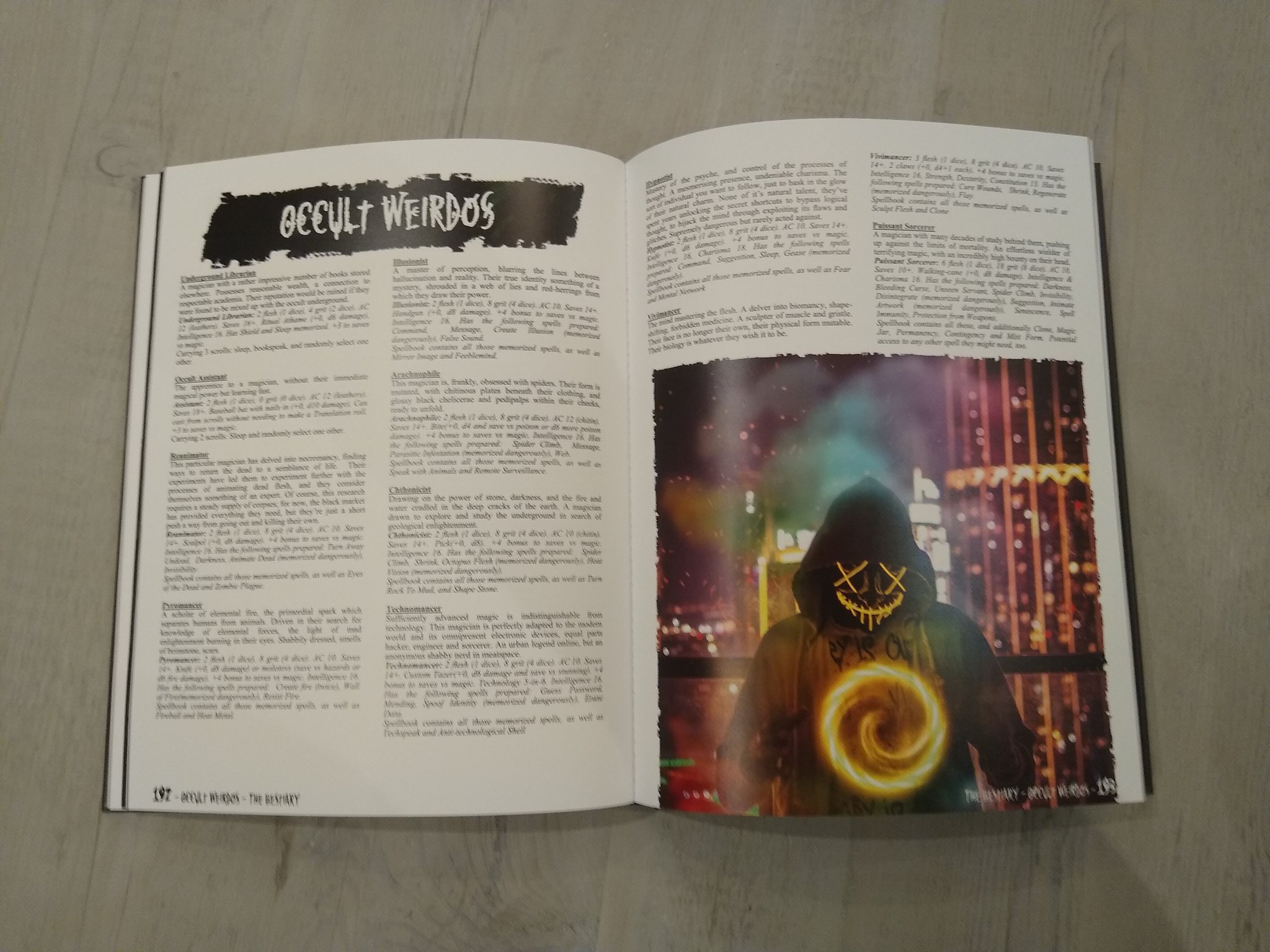
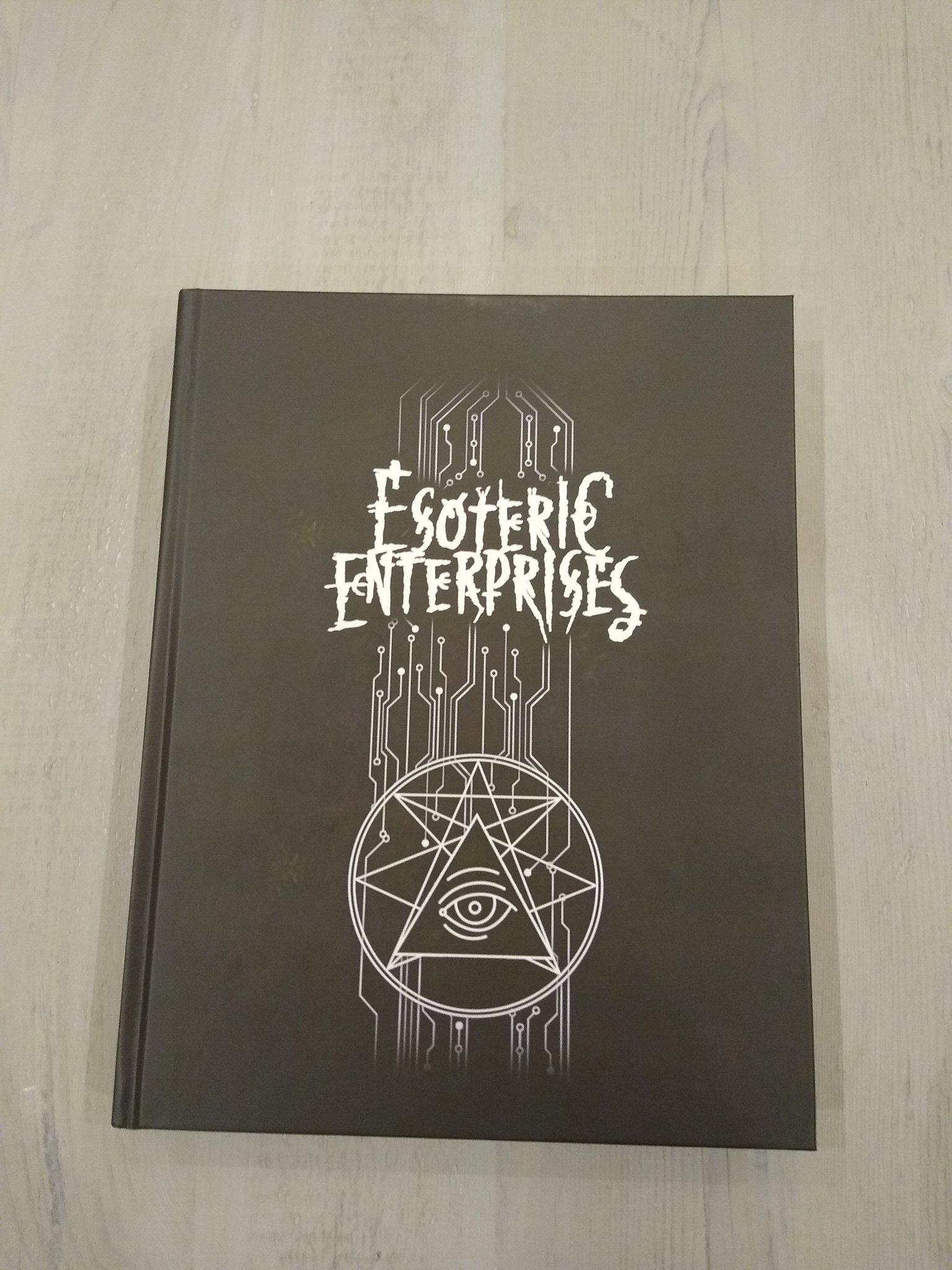
Here's some pictures of the actual book:


Print copy available here. The print version is hardback, high quality, full colour. It's a limited run, rather than PoD, so get it while it's still there, I don't know when the next run will happen.
PDF available here.

Sunday, 8 December 2019

Class - The Corpse Doll

Because I like the idea of Nechronica but am unlikely to ever actually play it. And because I also like franken-fran, zombieland saga, and the general idea of melencholy gruesome corpse-girls. If your GM lets this in their game, they're fucked up and I approve.
I made a whole class of zombie waifus and nobody can stop me. 

I am a shameless weeb. Also this show is really good, y'all. S2 confirmed.


This was once a girl.
Somebody loved her, before she died. Couldn't face losing her. Refused to let the grave claim her. 
There are ways to bring the dead back, as well. Not wholesome, healthy, sane ways of course, but they work. Dig up your dead love, draw the right sigils, speak the right words, and that cold flesh will stir into... not life, exactly, but animation. Or perhaps inject her carcass with chemicals to kick-start the processes of life that have fallen still. Or make a pact with some dark patron to bring her back. Or hollow her lifeless body out, and fill it with clockwork and springs, set it back into motion. They're all insane, but they work every time.
Her body, moments ago lifeless and empty, stirs into motion. Eyelids flutter open, lips part to draw breath once more. On the surgeon's slab, she pulls herself upright. For any reanimator, it's a moment of elation to see her come back.  

A digression. 
Death, if you consider him really a person at all, has a sharp sense of humour. Why do you think he has that constantly-grinning skull-mask. Why is the last sensation when you die of hypothermia unexpected warmth? Life is a cruel joke, and Death is waiting at the end to share his punchline with us.

So. The clay corpse shifts and rises, as if waking from a long sleep. And here, then is Death's little jest at those who think they can defy him.

Maybe the soul doesn't return. Maybe clinical brain-death wipes the electrically-encoded memories. Maybe the waters of Lethe erase the spirit's memories. 
In any case, the thing that rises on the slab isn't her.

Her eyes are blank. Her face vacant. She doesn't remember him. She doesn't remember herself. Whatever he had hoped to achieve, she's a failure.

As I say, Death is laughing at us.

So, what happens to her? Most times, the reanimator destroys what he had created in disgust. The creature on the slab isn't his lost love, so what does she matter to him. Sometimes she's cast out into the world. Sometimes she escapes. 

Occasionally, she'll survive long enough to make a new life for herself on the fringes of society. 


Hit Dice: d6
Saves: As a Thief
Attacks: As a Thief
Equipment Restrictions: As a Thief
Experience: As a Magician
She can have any alignment; despite her gruesome origin, she is a blank slate morally and spiritually.
If your system uses it, her Prime Requisite is either Charisma or Constitution.

Unnatural Animation: A Corpse Doll is vulnerable to anything that targets undead things specifically, things created by evil magic, or unnatural things. She takes damage from holy water as normal. She takes double damage from holy things. Paladins have a tendency to try to smite her, and angry mobs have a tendency to run her out of town when they find out what she is.
Unambiguously Dead: A Corpse Doll doesn't really have functioning biology like a living thing. She functions just fine if her heart, brain, etc are destroyed, and so doesn't take additional damage from backstabs, critical hits, etc. She has no need to breath. She doesn't really age, although she will probably need to be careful to avoid rot setting in. While she doesn't 'sleep' per se, she must still spend an equivalent amount of time each day maintaining the stitching that keeps her together, keeping her embalming fresh, and so forth; if she neglects this, she suffers the same penalties as a human who doesn't sleep to represent the general degredation of her physical condition. She is immune to most poison and sickness (except those that might cause dead flesh to decay such as Mummy Rot).
Diet: It is an unfortunate fact that a Corpse Doll still requires sustenance to maintain animation. She must eat raw, fresh meat (ideally immediately after the prey has been killed), without which she will starve like any living being. There is no need for this to be human meat, but people often make assumptions.
Stitch Back Together: A Corpse Doll cannot be healed by most magic (certainly not by clerics), and doesn't heal naturally. Instead, she must physically replace her lost flesh by stitching new bits onto herself. This requires three hours' work for each HP to be restored, and a source of replacement body parts. As a rule of thumb, a human corpse is good for 6 HP if the whole thing is used. Larger or smaller corpses (or partial corpses) will vary how many HP the Corpse Doll can restore from them. Some monsters don't have flesh and bones suitable for this (it's no good trying to stitch on bits from a golem, ent or fire elemental, for example), and using non-human body-parts will result in the doll looking even more monstrous than normal; if she repairs herself by replacing an arm with one taken from a giant crab, people will see this and react accordingly. Which corpses can replenish the Doll's HP, and by how much, are a matter of GM discretion.
Staple Bits On: If a Corpse Doll can stitch an organ or body-part onto herself that is responsible for a monster having some power or ability, then she might (at the GM's discretion) gain that power. For example, she could gain a poison bite by grafting snake-fangs into her mouth, flight by stapling wings onto her back, or a rusting touch by stitching rust-monster feelers onto her hands. Like when she repairs damage, this requires a half-day's work.
We Can Rebuild Her! If a Corpse Doll dies completely, she's not necessarily gone. If her team-mates recover at least a bit of her body (even just a scrap of muscle is enough), and make a new doll, incorporating some of her previous body, the she can return. Essentially, this means that anybody who knows what she is can resurrect her exactly as if they were casting Clone on her, without needing to actually have access to the spell.
Damned Creepy: A Corpse Doll who openly reveals her unnatural nature causes enemies to make reaction and morale rolls at -1.
Damned Addictive: A Corpse Doll's flesh carries some lingering remnant of the obsession that spawned her. If she can trick, coerce or force somebody into physically ingesting some of her flesh or blood, then the victim must Save vs Magic or be Charmed by her as if by the spell. She can only have one such person Charmed in this way at a time, if she charms a new victim, the previous victim is released.
Angst: There's no mechanics for this, but honestly if you're gonna play the monstrous husk of a reanimated girl and not wallow in torment and self-doubt, what's even the point?


Thursday, 5 December 2019

Class - The Abyss Mystic

2 And the earth was without form, and void; and darkness was upon the face of the deep. And the Spirit of God moved upon the face of the waters.
3 And God said, Let there be light: and there was light.
We live in a world of light, form, stability, reality. Everything the light falls upon is defined. Pinned into place by the act of witnessing it.
It was not always this way. Before the creation of light chained the world into its current form, darkness reigned. Things were imprecise, mutable, filled with potential. Far from being empty, there were intelligences in the dark, beings of the abyss. The world was a constantly-shifting quantum foam, and these creatures shaped it to their whim.
Such true darkness is rare in our current world. Mere night-time is still touched by the faint light of the moon and stars. To escape the light entirely, one must travel into the depths of the ocean, into the lowest points of the oldest dungeons, into the deepest veins of the earth. One must descend into the abyss. Here, the world is truly lightless. Here, free from the restrictions of vision and reality, one can commune with the true darkness that predated creation.

Few mortals have any clue as to the potential held in the darkness. To turn away from the light, to willingly blind oneself and immerse oneself in the void is seemingly insane. There are a few, though, who know what is possible. Who study the true black arts. Who draw upon the darkness and channel its power.
Such individuals are frequently found in the company of adventuring parties, hoping to be taken into the earth's depths, to encounter the true darkness that can be found down there.

Hit Dice: d4
Saves: As a Magic User
Attacks: As a Thief
XP: As a Magic User
Equipment Restrictions: As a Thief
Alignment: Must be Chaotic

Darksight: In absolute darkness (including supernatural darkness), an Abyss Mystic can navigate as easily as broad daylight. This ability does not grant any ability to see better in low-light conditions. Even very dim light ruins darksight, leaving the Abyss Mystic groping about in the gloom like anybody else.
Veins of the Earth says magic darkvision doesn't really work in the veins. This stuff explicitly does; the darkness of the veins is an asset to an abyss mystic, not an impediment.
Channel The Abyss: By vomiting forth the shadows within themselves, an Abyss Mystic can create a pool of absolute darkness in a 10 foot radius around them. Doing so costs the Abyss Mystic 1 HP as they draw out the darkness inside them. This pool of darkness follows the mystic if they move, and lasts until they sleep or choose to dismiss it.

Abyss Mysticism: In absolute darkness, an Abyss Mystic can invoke the darkness from before creation to create supernatural effects, equivalent to the spells used by other classes.
To do this, they choose which spell they wish to cast, and roll a casting dice, which is normally a d20. If the result is their level, or less, the spell is successfully cast.
For each round spent gathering abyssal power before casting, reduce the size of the casting dice by 1 step (from a d20 to a d12, then d10, d8, d6 and finally d4).
If the maximum result on the casting dice is rolled (IE a 20 on a d20, a 12 on a d12, etc), then the spell automatically fails, and the mystic's form begins to dissolve into primordial darkness. They take as much damage as their maximum HP total. Roll the casting dice again, and reduce the damage taken by that much.
Example:
 A 3rd level Abyss Mystic with 9 HP wishes to cast Silence. There is no absolute darkness nearby, so they must create some using Channel the Abyss (taking 1 damage in the process, reducing them to 8 HP). They then spend two rounds gathering power, reducing their casting dice from a d20 to a d10. On the third round, they attempt to cast the spell, rolling a d10. 
If the result is 1-3 (their level or less), the spell is cast successfully.
If the result is 4-9, the spell fails but nothing bad happens.
If the result is 10 (the maximum possible), they begin to dissolve into shadow. They take 9 (their maximum hp) minus d10 (the casting dice) damage.

At first level, they know only a single spell of the Abyss. At each level, they learn another spell, either randomly chosen or of the Abyss Mystic's choice, depending on how the game you're running handles it. Abyssal spells don't use spell ranks; count them all as 1st level spells for any effect that cares.

Abyssal Spells:

  1. Abyssal Tar. Duration 1 round/level. Radius 30 feet. This spell causes the darkness to become almost tangible, slowing and constraining those within it. Any creatures within the spell's radius in absolute darkness move at half speed, and are only able to attack, cast spells or take other such dramatic actions every other round (as if affected by a Slow spell). Those in deep shadow, but not absolute darkness, get to make a Save vs Paralysis to resist the spell's effect each round. Creatures immune to darkness, such as Abyss Mystics, are immune.
  2. Arms of the Abyss.. Duration 1 round/level. Range 20 feet. This spell creates a semi-tangible black tendril that emerges from an area of shadow or darkness that the mystic can see. The arm can extend out to ten feet in length, and can manipulate objects with as much dexterity as a human hand. If issued a command by the mystic, the arm obeys, otherwise it will lash out blindly at its surroundings. It can attack (as a 1-hd monster), dealing d4 damage on a hit, or else grapple, snatch items, etc like any other creature. It has as many HP as the mystic's level. Exposure to light is harmful to the arm; it takes 1 damage a round if exposed to any light at all, while brighter light (such as torchlight) deals d4 damage a round, and full daylight does d12 a round.
  3. Charm Shades. This spell functions exactly like the spell Charm Person, except that it only effects non-physical undead or extra-planar creatures such as ghosts, invisible stalkers and so forth. Shadows, Shades and other monsters explicitly made of shadow or darkness get no save to resist the spell. Exposing the subject to bright light ends the spell immediately.
  4. Control Shadows. Duration 1 round/level. Radius 30 feet. During the spell's duration, the mystic controls the shape, movement, depth and extent of all shadows within the effect's radius (which might extend outside the pool of absolute darkness created by the mystic). They can create shadows of things that aren't there, create enough shadow for team-mates to hide in, extend pools of shadow over an enemy's eyes to blind them, or create shadows that another of the mystic's spells can make use of.
  5. Create Sensations. Duration 1 round/level. Radius 30 feet. During the spell's duration, the Mystic can create illusory sensations for any sense except vision. They can create tactile sensations, noises, smells, tastes, and even spoof unusual senses possessed by creatures (such as a shark's ability to detect electrical charge). The sensations can be tailored so different victims experience different things. There is no save initially, but a Save vs Magic is allowed when a victim has evidence that the sensation might be false, allowing them to tell for sure that it's only an illusion.
  6. Dissolve into Darkness. Duration 1 round/level. During the spell's duration, the mystic's physical form evaporates, leaving only a two-dimensional shadow behind. Equipment carried by the mystic is likewise transformed. Whilst two-dimensional in this way, the mystic cannot be physically touched or touch things, and is immune to most attacks. They can move only slowly - 10 feet per round - as their form slithers across whichever surface it's projected onto. When not hidden in darkness or shadow, exposure to dim light deals 1 damage to them per round, exposure to brighter light (such as torchlight) deals d4 damage per round, and sunlight or equivalent does d12 damage per round. The mystic can still cast other abyssal spells in this form.
  7. Enlarge/Shrink. (as the existing spell).
  8. Extinguish. Range 20 feet. This spell completely extinguishes a single fire or light source within range. 
  9. Eyes of the Abyss. Duration 1 round/level. Radius 30 feet. During the spell's duration, the mystic can see (and hear, touch, smell etc) everything that happens in any absolute darkness in the spell's radius, granting them a sort of limited-radius omniscience. The spell allows them to see through illusions, invisibility, etc within the spell's area of effect. 
  10. Feather Fall (as the existing spell)
  11. Peer Through The Abyss.. Duration 1 round/level. This spell functions exactly like the spell Clairvoyance, except that when used the mystic can only perceive things in absolute darkness. Anything in even very slight light cannot be viewed by the spell.
  12. Reach Through Shadows. Duration 1 round/level. Radius 30 feet. During this spell's duration, the mystic can reach their hand into the darkness surrounding them, and have it emerge from any shadow or darkness in range, up to the shoulder. Anything they grab can be pulled back to the mystic, or they can use the spell to place things away from them.
  13. Sever Shadow.. Range 20 feet. The mystic can extend a knife of shadow from the darkness they lurk in, attacking the shadow of an enemy nearby. As the enemy's shadow is ripped apart, corresponding wounds appear on their body. The victim must be illuminated enough to cast a distinct shadow, which must fall within the spell's 20 foot range. The shadow-knife hits automatically, dealing d6 damage plus the Mystic's level.
  14. Shroud.. Duration 1 turn/level. The mystic pulls a shroud of shadow over their allies, concealing them. The spell's subject (who must be within the mystic's pool of darkness when the spell is cast) gains the Hide In Shadows ability of a Thief, of the mystic's level. If the subject is already a thief (or otherwise has this ability), then add the mystic's level to their own for the purposes of their chance at hiding.
  15. Silence (as the existing spell)
  16. Step Through Shadows.. Range line-of-sight. The mystic steps into the darkness, and emerges from any area of shadow or darkness they can see that is large enough to fit their whole body into.
  17. Spider Climb (as the existing spell)
  18. Undo The Chains of Light. Duration 1 round/level. Radius 30 feet. This spell causes things to revert to the state they were in before light and space gave things solid, tangible existence, dissolving into their dark, primordial potential. Everything and everybody within the spell's radius is affected. Objects slowly degrade over time, crumbling to black dust, and then dissolving into raw darkness, although this will take hours to complete. Creatures are more vulnerable; it only takes a little disruption for the orrder that makes life possible to be disrupted. A creature in sunlight or similar light is unaffected. A creature in bright light (such as torchlight) takes 1 damage a round, a creature in dim light takes d4 damage a round, and a creature in absolute darkness takes d12 damage a round. Creatures immune to darkness (such as Abyss Mystics) are unaffected.
  19. Unseen Servant (as the existing spell)
  20. Water Breathing (as the existing spell)


Tuesday, 3 December 2019

Hrud for Kill Team - final rules

Strategies

Glimpsed Shadows
Hrud Tactic 
Use this Tactic at the beginning of the first battle round. Pick a model from your kill team and set it up again, anywhere in your deployment zone.
2 CP

Warp Space
Hrud Tactic 
Use this Tactic after a model from your kill team shoots in the Shooting phase. The model can immediately make a normal move of up to 7" as if it were the Movement phase.
1 CP 

Slippery Blighter 
Hrud Tactic 
Use this Tactic after a model from your kill team Falls Back. That model can still shoot this battle round.
1 CP

Entropic Bait
Hrud Tactic 
Use this Tactic at the start of the Shooting phase. Pick a model from your kill team that is within 2" of a HRUD WARRIOR model. Until the end of the phase, while that Hrud Warrior model is on the battlefield, any attacks which target the chosen model are resolved against that Hrud Warrior model instead.
2 CP

Distortion Field
Hrud Tactic 
Use this Tactic in the Movement phase. Pick a model from your kill team that has not yet moved. That model may not move this phase, but for the rest of the battle round, if this model is obscured, shooting attacks that target this model suffer an additional -1 modifier to their hit rolls.
1 CP

Toxic Smog 
Hrud Tactic 
Use this Tactic at the start of the Fight phase. Pick an enemy model that is within 1" of any of your HRUD POISONER models and roll a D6. On a 4+, that enemy model suffers 1 mortal wound.
2 CP

Distortion Tunnels
Hrud Tactic 
Use this Tactic at the end of the Movement phase. Choose up to three HRUD models from your kill team that were set up in Reserve and set them up anywhere on the battlefield that is more than 5" away from any enemy models.
1 CP

Units

Hrud Warriors
Hrud Warrior: Movement 6", WS 5+, BS 4+, Strength 2, Toughness 2, 1 Wound, 1 Attack, Leadership 4, 6+ Save, no max.
Hrud Warrior Gunner: Movement 6", WS 5+, BS 4+, Strength 2, Toughness 2, 1 Wound, 1 Attack, Leadership 4, 6+ Save, 2 max.
Hrud Elder: Movement 6", WS 5+, BS 4+, Strength 2, Toughness 2, 1 Wound, 2 Attacks, Leadership 5, 6+ Save, 1 max.
Equipment: Scavenged Small-arm.
Options:
This model may replaces its Scavenged Small-arm with a Scavenged Long-arm, a Scavenged Shotgun, or a Marksman's Rifle.
A Hrud Warrior Gunner may replace its Scavenged Small-arm with a Flamethrower, a Scavenged Machine-gun, a Rocket Launcher or a Hrud Warp Fusil.
A Hrud Elder may have a Poison Blade.
Special Rules:
Squirmy Anatomy: This model can climb any distance vertically (up or down) when it makes a normal move – do not measure the distance moved in this way.
Shadow Field: When an opponent makes a hit roll for a shooting attack that targets this model, and this model is obscured, that hit roll suffers an additional -1 modifier. 
Specialists: Leader (Elder only), Heavy, Coms, Scout, Sniper,
Faction Keyword: Hrud
Keywords: Infantry, Hrud Warrior

Hrud Poisoners
Hrud Poisoner: Movement 6", WS 5+, BS 4+, Strength 2, Toughness 2, 1 Wound, 1 Attack, Leadership 4, 6+ Save, no max.
Hrud Poisoner Fighter: Movement 6", WS 5+, BS 4+, Strength 2, Toughness 2, 1 Wound, 1 Attack, Leadership 4, 6+ Save, 1 max.
Hrud Chemist: Movement 6", WS 5+, BS 4+, Strength 2, Toughness 2, 1 Wound, 2 Attacks, Leadership 5, 6+ Save, 1 max.
Equipment: Scavenged Small-arm.
Options:
This model may replaces its Scavenged Small-arm with a Poisoned Blade, a Scavenged Shotgun, or a Chainsaw.
A Hrud Poisoner Chemist or Fighter may have a Smog-generator.
A Hrud Poisoner Chemist may have a Poisoned Blade or a Chainsaw.
Special Rules:
Squirmy Anatomy: This modelcan climb any distance vertically (up or down) when it makes a normal move – do not measure the distance moved in this way.
Shadow Field: When an opponent makes a hit roll for a shooting attack that targets this model, and this model is obscured, that hit roll suffers an additional -1 modifier. 
Smog-generator: Subtract 1 from the Leadership characteristic of enemy models within 6" of any models equipped with a Smog Generator
Specialists: Leader (Chemist only), Coms, Scout, Combat, Medic
Faction Keyword: Hrud
Keywords: Infantry, Hrud Poisoner

Hrud Scavengers
Hrud Scavenger: Movement 7", WS 4+, BS 4+, Strength 3, Toughness 3, 1 Wound, 1 Attack, Leadership 5, 6+ Save, no max.
Hrud Scavenger Gunner: Movement 7", WS 4+, BS 4+, Strength 3, Toughness 3, 1 Wound, 1 Attack, Leadership 5, 6+ Save, 1 max.
Hrud Saboteur: Movement 7", WS 4+, BS 4+, Strength 3, Toughness 3, 1 Wound, 2 Attacks, Leadership 6, 6+ Save, 1 max.
Equipment: Scavenged Long-arm.
Options:
This model may replaces its Scavenged Long-arm with a Marksman's Rifle.
A Hrud Scavenger Gunner may replace its Scavenged Long-arm with a Flamethrower, a Scavenged Machine-gun, a Rocket Launcher, a Hrud Warp Fusil or a Hrud Warp Bombard.
A Hrud Saboteur may have a Poisoned Blade, or replace its Scavenged Long-arm with a Scavenged Shotgun.
Special Rules:
Squirmy Anatomy: This modelcan climb any distance vertically (up or down) when it makes a normal move – do not measure the distance moved in this way.
Shadow Field: When an opponent makes a hit roll for a shooting attack that targets this model, and this model is obscured, that hit roll suffers an additional -1 modifier. 
Spotter: At the start of each Shooting phase, you can choose another HRUD model within 3" of a Hrud Scavenger that is not shaken. That model does not suffer penalties to their hit or injury rolls due to their target being obscured.
Specialists: Leader (Saboteur only), Coms, Scout, Heavy, Sniper, Demolitions, Veteran
Faction Keyword: Hrud
Keywords: Infantry, Hrud Scavenger

Gear

Ranged Weapons
Flamethrower: Range 8", Assault d6, Strength 4, AP 0, Damage 1, This weapon hits automatically.
Marksman's Rifle: Range 36", Heavy 1, Strength 4, AP 0, Damage 1, A model firing a sniper rifle does not suffer the penalty to hit rolls for the target being at long range. If you roll a wound roll of 6+ for this weapon, it inflicts a mortal wound in addition to its normal damage. 
Hrud Warp Bombard: Range 30", Heavy 4, Strength 5, AP 0, Damage 1, This weapon can be fired at models that are not visible to the bearer. If the target is not visible to the bearer, a 6 is required for a successful hit roll, irrespective of the firing model’s Ballistic Skill or any modifiers. 
Hrud Warp Fusil: Range 30", Heavy 1, Strength 8, AP -4, Damage d6, This weapon can be fired at models that are not visible to the bearer. If the target is not visible to the bearer, a 6 is required for a successful hit roll, irrespective of the firing model’s Ballistic Skill or any modifiers. 
Rocket Launcher: Range 24", Pistol 1, Strength 8, AP -2, Damage 3, No special rules.
Scavenged Machine-gun: Range 36", Heavy 3, Strength 4, AP 0, Damage 1, No special rules.
Scavenged Long-arm: Range 24", Rapid Fire 1, Strength 3, AP -, Damage 1, No special rules.
Scavenged Shotgun: Range 12", Assault 2, Strength 3, AP 0, Damage 1, If the target is within half range, add 1 to this weapon's strength.
Scavenged Small-arm: Range 12", Pistol 1, Strength 3, AP 0, Damage 1, No special rules.

Melee Weapons
Chainsaw: Melee, Strength As User, AP 0, Damage 1, When a model attacks with this weapon, it can make a single additional attack.
Poison Blade: Melee, Strength n/a, AP -2, Damage 1, This weapon wounds on a 4+.

Points Costs

Ranged Weapons:
Flamethrower 2 Pts
Hrud Warp Bombard 5 Pts
Hrud Warp Fusil 4 Pts
Marksman's Rifle 1 Pt
Rocket Launcher 3 Pts
Scavenged Machine-gun 1 Pt
Scavenged Long-arm 0 Pts
Scavenged Shotgun 0 Pts
Scavenged Small-arm 0 Pts

Melee Weapons:
Chainsaw 0 Pts
Poison Blade 2 Pts

Other Equipment:
Smog-generator 3 Pts

Models:
Hrud Warrior 7 Pts
-Hrud Warrior Gunner 7 Pts
-Hrud Elder 7 Pts
Hrud Poisoner 6 Pts
-Hrud Poisoner Fighter 6 Pts
-Hrud Chemist 7 Pts
Hrud Scavenger 7 Pts
-Hrud Scavenger Gunner 7 Pts
-Hrud Saboteur 8 Pts

Hrud for Kill Team - the design process

The Hrud appear in 40k's background but haven't, to my knowledge, ever been given official rules. So here's me writing up some rules for them, so I can use them in Kill Team.
First up, our goals for the rules.
What do we know about the Hrud as a race?

  • They live mostly underground, prefer dim light, and dislike bright lights.
  • They generate a distortion field from their bodies that make them hard to pinpoint and often hide them in a pool of shadow. 
  • Their bodies are highly toxic, and they can create a wide variety of poisons.
  • They accelerate entropy around them, causing things to decay quickly and those nearby to age prematurely.
  • Their bodies are unusually flexible, well suited to climbing and squeezing.
  • They have comparatively little of their own technology, and tend to use scavenged equipment from the 'host civilisation' of whichever world they infest.
  • They undergo mass migrations when their populations rise particularly high.
  • They make use of unique warp technology, letting them distort space and time, move between worlds, and other strange feats.
  • Their signature weapon is the Warp Fusil, which fires a bolt of plasma through the warp to strike its target unprepared.
From this, a particular play-style emerges that seems appropriate. The Hrud are individually weak and often encountered in large numbers. They're relatively mobile, hard to pin down and making excellent use of cover. Their tactics are based on hit-and-run strategies, ambushes, and sniping rather than brute force. Most of their weaponry is poor, but they have a few devastating heavy weapons.

So.
Let's work out the base Hrud stats.

For the baseline, let's take a Grot from the ork list. This line-up is appropriately shit, and only costs 4 points.
Next up, let's make this stat-line sneaky. How do we do this? Well. The cost of an Ork Boy is 6 points. The cost of a Komando is 8 points. The difference between the two is that a Komando gets an extra point of Movement and the Sneaky Gits (enemies suffer -1 to hit while the model is obscured) rule. Their stats and gear are otherwise identical. So, we can conclude that +1 movement and the 'Sneaky' rule is worth two points.
We can re-fluff the grot's (rather shit) Grot Blaster as a scavanged weapon, and explain its low stats as a result of its being degraded by the entropic field the hrud produce.
Lastly, moving outside the Ork list, the Astartes Reivers get access to a Grapnel Launcher (ignore vertical distance while moving) for one point.

This gives us a stat-line of:
Hrud WarriorsMovement 6", WS 5+, BS 4+, Strength 2, Toughness 2, 1 Wound, 1 Attack, Leadership 4, 6+ Save.
Squirmy Anatomy (Ignore vertical distance when climbing)
Shadow Field (enemies suffer an additional -1 to hit while this model is obscured)
Scavenged Small-arm (12" range, Pistol 1, Strength 3, no AP, Damage 1).
For a total of 7 points. This seems suitably sneaky, and can represent a standard Hrud warrior.

Now, it seems only fair to give them a second troop choice, this one a dedicated scavenger, used to having to defend itself from other races. Let's pick something a little tougher than Grots for the baseline, but only barely; chaos cultists. Again, give it the squirmy anatomy and shadow field, for +3 points. Then, to represent their use as scouts, an auspex is one point: we can re-fluff this as special training.  
Hrud ScavengerMovement 7", WS 4+, BS 4+, Strength 3, Toughness 3, 1 Wound, 1 Attack, Leadership 5, 6+ Save.
Squirmy Anatomy (Ignore vertical distance when climbing)
Shadow Field (enemies suffer an additional -1 to hit while this model is obscured)
Spotter (pick a friendly model within 3" at the start of the shooting phase. That model ignores penalties for their target being obscured)
Scavenged Long-arm (24" range, Rapid Fire 1, Strength 3, no AP, Damage 1)
Costing us a grand total of 8 points. 

Our final troop-type will be poisoners. These will use the same stat-block as hrud warriors, but also get the option to take a 'choking cloud' item; the aura of '-1 leadership' a chaos Icon of Despair produces, at the same points cost. Other than that, their main difference to standard hrud is the gear they can take, which is close-range focussed.


We can reverse-engineer the costs for Leader-type models for each troop type. Basically all of them cost 1 point more, and get +1 attack and +1 Leadership, and maybe some slightly better gear options. Gunners have various different points costs depending on the gear available, but this is pretty simple to work out. 

Weapons mostly have their costs right there, we can pick a few interesting weapons. Sniper Rifles, Flamers, and Heavy Stubbers seem fun. For their signature weapons - the Warp Fusils - I want to do something a bit special, though. 
The Tau have a weapon available called 'smart missile systems' costing 5 points, which can shoot at enemies not in line-of-sight (needing 6s to hit when doing so). This seems like a good way to model being able to shoot through the warp. A smart missile system has the same stats as a Burst Cannon (which costs 4 points), except that it is Heavy rather than Assault, 30 inch range, and gets the option to shoot out of line-of-sight. So, we can conclude that a range increase from 18 to 30, indirect fire, and going from Assault to Heavy is worth +1 point.
Now, to apply this to a suitably potent gun to produce the warp fusil's stats. The Dark Eldar get a Blaster, which is a powerful single-shot assault weapon, with 18-inch range, so that makes a nice base. The modifications above give us a potent single-shot heavy weapon that can ignore line-of-sight.

Lastly, let's pick a few Tactics for the Hrud. These are mostly gonna be coming from the Eldar/Dark Eldar/Nids and will focus on movement and cover.

And with that, we have the behind-the-scenes work done. Now all that's left is to put it together in a useable format, which will come in the next post.
The end result should be a GEQ list that's strongly focused on using and abusing cover. The list is more comfortable at long range, since they get better benefits from cover while shooting, and can negate the enemy's ability to benefit from cover in a few different ways. If an enemy tries to close with them, the Hrud have a few Tactics they can use to pull back and keep shooting, and their ability to climb for free means they can dart about vertical terrain that slows down most other troops coming after them.


Sunday, 24 November 2019

The Kiasyd Bloodline for Vampire 5th Edition

This is all completely unofficial. I have no idea what WW plans to do with the Kiasyd for v5, or even if they'll make it into the game at all. However, they're one of my favourite bits of the VtM setting, so I thought I'd put together some homebrew for them.
The book detailing the discipline Oblivion has not yet been released from what I can tell, but you can find the discipline online with a little googling.
I don't think any of this is wildly unbalanced, but it's my first attempt brewing anything for v5. Feedback is useful.
I also have no idea what the actual legal situation with publishing 3rd party stuff for v5 is. I'd certainly be interested in making a zine-sized booklet for people who want to play my favourite weirdlings in v5, but I *also* don't want to get sued. If anybody knows what the situation is with selling fan stuff for v5 I'd be keen to hear from y'all.  

And with that preamble out of the way...


The Kiasyd
Also known as Maeghyr, Weirdlings, Broken Butterflies, Fair Folk, Moths, Greys 

The Kiasyd are an oddity among vampires. Not really a clan, but not clanless like the Caitiff or Thin-blooded. Something else. The vitae in their veins remains as potent as that as any kindred, but altered. They claim to be an offshoot of the shadowy clan Lasombra, to be fairies who were embraced, to be children of the abyss, to be the products of alchemy, to be a natural evolution of the vampiric form, to be nightmares crawled out into the waking world. They make all these claims at once, and say that all of them are equally true. 
What is known is that the bloodline are reclusive, scholarly and eccentric. They prefer their own company, but claim an old tradition prevents more than two - one master, one student - ever inhabiting a domain. They say that for the longest time, they were property of the Sabbat, but with that sect abandoning it's territorial struggles to pursue its own goals in the middle-east, the Kiasyd seem to have been left behind. And as vampire society falls apart, the weirdlings - now unhindered by sect or status - continue their strange studies. 

"You see, child, there's far more to the world than what they would have you believe. They tell you that our enemies are mortal inquisitors, but those are lies. Filthy lies! Things stir in the abyss, and the ripples move mortals like leaves on the surface of a pond."
"The abyss is our grandmother, you know. The grand maw, if you will. Lucien was in love with her, and he had Gratiano send him to her. He dwells within her still. Grandmaw and Lucien gave rise to the siblings Hrotsuitha and Marconius. And their union - incestuous though it might have been - is where we came from."
"Gratiano diablerized his sire, you say? Of course. What is Diablerie but an act of love? A uniting of souls. Again, the Camarilla will deny this, but they lie."
"Marconius was an alchemist. He took the blood of the things that crawl in the dark. Things whose nature defies categorising. We call them the Unseelie, the Neverborn, the Fomorians, the Thallain, the Nephwracks, the Lilim. Zeernebooch, too, whoever that is. He put all of that into an elixir, and his sister drank it, and in the dark of the grand maw, they gave birth to us."
"This is what the other vampires fail to understand. We aren't like them, not really. The resemblance is like that of cousins, not siblings. Wherever we came from, we sidestepped all this grand destiny of the Cainites nonsense. We have deeper mysteries to fathom." 
"Rest assured, things are changing. Marconius sits in Stratsbourg, vacant-eyed and gibbering. The shadows lengthen every night, and every dawn they creep back a little less. I spoke to a redcap, and he told me that the long winter is coming. I spoke to one of the Bahari, and she muttered prophecies of Gehenna. I spoke to a mortwight, and it said Grandmother stirs in her sleep. The name of Hrotsuitha is on everybody's lips. The inquisitors are just puppets, my child. They're clearing the way for what comes next."

Who Are The Kiasyd?
A few factors unite the weirdlings. All possess a connection to supernatural forces outside of vampire society, as well as an unhealthy curiosity and an eccentrically refined taste. They are antiquarians, gourmands, occultists and alchemists. They value those secrets that fall through the cracks of acceptable research. They collect - facts, artefacts, servants, texts, experiences - things that other vampires might overlook. 
Although no Kiasyd would embrace one with common taste, there is more to it than this. Something in their blood alters them, twisting their minds to become something weird and whimsical. They follow fairy-tale logic, abide by long-extinct superstitions, and are driven by odd fascinations. 
This effect is not purely psychological, either. The embrace alters a Kiasyd's form far more than that of most other Kindred, save perhaps the nosferatu. The precise changes vary from weirdling to weirdling, but there are common patterns. As a rule, the Kiasyd are tall, pale, delicate and androgynous. Some have their bodies stretched out to seven feet tall or more. Some find their skin becoming albino, or blue-tinted, or grey-violet. Their eyes often become pure black, or else oddly coloured. Their ears become subtly pointed, their fingers become spider-like, their skulls strangely narrow. Stranger features emerge sometimes, too. Extra digits, joints that don't bend the way they should, forked tongues, chicken claws.
A given Kiasyd's appearance falls somewhere on a scale between art-nouveau muse, elf, exsanguinated corpse and grey-alien. Some can pass themselves off as humans, if striking looking ones. Others must cover their particular alterations beneath concealing clothing, or wear heavy makeup in order to appear in public. The strangest of them would cause instant masquerade breaches, resembling the sort of creature rarely seen in the waking world.
This obvious strangeness, combined with the historical restrictions placed on their line, have led to the various traditions of their kind. They are highly reclusive, but unflinchingly polite and gracious hosts. They take pains to avoid gathering in greater numbers than a simple pair. The exception to this is their occasional conclaves - of which there have been less than a dozen in the line's entire history - at which they gather in great numbers to discuss academic and political matters.
Considering recent upheavals in vampire society, as well as the rumours that spread like wildfire among their kind that deeper, darker forces are at play, it seems that they will soon be meeting for another such conclave. 


Disciplines

Auspex
As scholars of the weird and forgotten, Auspex is invaluable to the Kiasyd. Auspex allows a weirdling to investigate and experiment in ways they otherwise couldn't, and most value the insights it grants them. In particular, the Kiasyd make great use of Auspex in detecting and studying the various other supernatural denizens of the world, including ghosts, fairies and mortal psychics.

Dominate
The Kiasyd are creatures of etiquette and tradition, even if those particular traditions are sometimes not recognised by those around them. The capacity to enforce their particular social mores is, therefore, rather useful to them. Furthermore, many Kiasyd are frankly bizarre looking or behave in ways that are distinctly inhuman. The capacity to adjust and alter the memories of mortals who encounter them allows them to preserve their privacy and avoid unwanted attention.

Oblivion
Every Kiasyd is, in some way, touched by inhuman forces. They characterise these things differently; some talk about the realm of nightmares, others the abyss, or the darkness from before creation, or the maw of oblivion. None the less, all know that there's something distinctly unnatural about them, even by the standards of vampires. Of course, being the unusual types they are, this connection to the weird is a point of pride for them, and many draw on Oblivion as an overt demonstration of their bizarre nature.

Bane
A Kiasyd's physique and psychology is odd, reflecting their unnatural origins. They must take two points of the flaws Folkloric Bane and Folkloric Block (either two banes, two blocks or one of each). Furthermore, they are affected more severely by these blocks & banes than other vampires. Increase the damage dealt by a Folkloric Bane by their Bane Severity. Likewise, they must spend extra Willpower (as many points as their Bane Severity) to overcome a Folkloric Block.
Their unusual physiology means that many Kiasyd also possess appearance-based merits and flaws, but like most things about the weirdlings, the specifics of a Kiasyd's appearance and how it's reflected mechanically vary wildly.

Clan Compulsion - Experimentation
Driven by the same strange forces that created them, the Kiasyd finds themselves with an urge to tinker, to take things apart to see how they work, to alter themselves or their subjects in weird and dramatic ways, to find new ways to do things. While driven by this compulsion, the Kiasyd takes a two dice penalty on any actions that are familiar, routine, or well understood. This penalty lasts until the Kiasyd's obsession with the novel and bizarre causes them to learn a new and better way of doing things, or to dramatically alter themselves or their surroundings.


Additional Options

New Predator Type - Cocktail Gourmet
You don't drink to live, but rather live to drink. Not for you, though, the crassness of glutting yourself on easy blood. No, your tastes are refined and exotic. You seek out new tastes, keep detailed notes on flavour, and combine them before imbibing. Where the common riff-raff are content to simply bite open a vein and drink directly from the vessel, that won't do for you. Rather, you extract the blood from multiple vessels, combine them carefully to balance the tastes, perhaps add seasoning or ice, and serve in a wineglass or silver goblet. It's rather an inconvenient, but the taste is exquisite. 
  • Add a Speciality: Craft (Bartending) or Medicine (Haematology) 
  • Gain one dot of Auspex of Dominate
  • Gain the feeding merit Bloodhound and the supernatural merit Eat Food
  • Gain 2 dots of herd.
  • Gain the feeding flaw Prey Exclusion (2 - unprepared blood) 
New Predator Type - Atrocity Host
You elevate feeding to an art-form. You are not satisfied by a careful sip here and there, nor do you let yourself be held back by ethical concerns. When you feed, it is an event. Your choice of location is carefully chosen, isolated and staked out ahead of time. The exits are secured, means of communication cut, and victims accounted for. Then, you and your guests feed. Perhaps your victims are flayed, so that you can lick the blood from their skinless bodies. Perhaps they're hung from the ceiling by hooks through their ankles, bled from the neck into silver chalices. Perhaps they're tied to chairs and have spigots driven into their chests, like tapping a keg. Every time, it's different, and you find new horrors to visit on your unfortunate victims before they die. Then, once the night's revelries are concluded, you clean up after yourselves, disguising the scene as a mundane tragedy, and move on, leaving nothing but corpses and grief behind.
  • Add a Speciality: Intimidate (torture) or Etiquette (parties)
  • Gain one dot of Dominate or Oblivion
  • Increase your Blood Potency by 1
  • Lose two dots of Humanity.
  • Gain the Dark Secret flaw (2 - committer of atrocities)
  • Gain the Enemy flaw (2 - escaped victim)
  
New Background - Marconian Alchemy
The Kiasyd are not like other vampires, and their blood is mutable. You've been trained by the elders of your line in the arts of blood alchemy, and have some ability to warp and mutate your own Vitae. Needless to say, this training gives you a great deal of prestige among your own kind, as well as unlocking the potential to evolve yourself even further. 
This background allows the Kiasyd to learn Thin-blood Alchemy despite not being thin-blooded themselves; the altered blood of the weirdlings is mutable enough to allow it. Your level of Thin-blood Alchemy is capped at your dots in Marconian Alchemy, and you must then buy Thin-blood Alchemy with experience points in the normal way. You can only use the Athanor Corporis distilation method for this.
Furthermore, the Kiasyd are not as adept at alchemy as the truly thin-blooded, and require further supernatural catalysts in order to make the process work. There is an additional cost of a blood sample from a non-vampiric supernatural being (or ichor, protoplasm, or whatever that being has in place of blood). It only needs to be a single drop, and it can come from all manner of beings (fairies, mortal psychics, werewolves, victims of possession, demons, zombies, or weirder creatures) but without it, the alchemy simply won't function.

Mytherceria - The Disciplines Powers Of The Kiasyd

Smelt Lies - Auspex 1
The Kiasyd has an ability to tell when they're being lied to, a sort of sixth sense that alerts them. How this manifests varies from Kiasyd to Kiasyd. Some find they taste lies as a bitterness in the air, others hear a hollow echo to the liars words or perceive a whispered correction in their ear. Needless to say, the ability to sift truth from deception in this way is invaluable to a line of scholars such as themselves.
Cost: One rouse check
System: When the Kiasyd suspects they're being lied to, they can rouse the blood in order to activate this power. The power succeeds automatically, with no rolls required. If whichever statement they're suspicious of was a lie, the Kiasyd senses it for certain; if they sense nothing, then the statement wasn't a lie.
This power detects deliberate lies. The Kiasyd can still be fooled by misleading (but technically accurate) wording, fast-talk or spin. Furthermore, if the speaker actually believes what they say to be true, then the Kiasyd doesn't sense anything. On the other hand, if the speaker doesn't know what's true, and just makes something up, the Kiasyd senses a lie.

Fey Sight - Auspex 2
The Kiasyd line has a connection to the stranger supernatural inhabitants of the world, and an ability to pinpoint weird magic and the beings that use it. With this ability, all the various creatures that hide in plain sight are laid bare to the Kiasyd, who instinctively senses their presence and feels when they use their magic.
Cost: Free
Pool: Intelligence plus Auspex
System: Whenever the Kiasyd encounters a supernatural being. they roll Intelligence plus Auspex reflexively, against a varying difficulty chosen by the ST - the more potent the being encountered, the lower the difficulty for a Kiasyd to sense it. If the roll fails, the Kiasyd only gets a sense that something is unusual, but no more.
If the roll succeeds, the Kiasyd knows instinctively that the creature it has encountered is supernatural, and gets a 'taste' for what sort of being it is. They might not know the name for what they've encountered, but they know if it tastes like similar creatures they've encountered previously. For example, all changelings the Kiasyd encounters share a common taste, however there are subtle distinctions between the taste of a redcap and a troll, and even subtler distinctions between the taste of of two different packs of redcaps.
Furthermore, if the creature encountered has a 'true' form that's hidden or shapeshifted out of, if the Kiasyd's roll succeeded, they percieve that true form superimposed on the being's normal appearance. For example, the Kiasyd would percieve a troll as both a normal mortal and an eight-foot hulking brute out of ancient mythology, simultaneously.
The power is likewise activated when the Kiasyd encounters a supernatural power in use, the after-effects of such a use, or when such a power is used in their presence. The roll is the same, and again if it fails the Kiasyd only gets a sense that something is unusual. If the roll succeeds, the Kiasyd tastes the sort of supernatural responsible, although they don't get any additional insight into what the power actually does.
This power has no capacity whatsoever to detect vampires, powers of vampiric blood, or vampire-created creatures such as ghouls and thinbloods.

Changeling Ward - Dominate 3
Amalgam with Oblivion 1
The Kiasyd can carve, paint, or tattoo warding patterns on things. Each such pattern is a densely-packed mess of symbols and marks that spiral in on themselves, exerting a dangerous hypnotic effect on anybody that observes it. Such victims find themselves caught in confused fascination, losing track of what they were doing before they encountered the ward. Most Kiasyd protect their havens heavily with such wards, creating overlapping layers of these defences that baffle and misdirect those not welcome. Some go so far as to inscribe such wards on their favourite possessions, thralls and even their own body; a Kiasyd who rips open her shirt to reveal such a ward carved into her chest can use the resulting confusion to great advantage.
Cost: One rouse check
Pool: Intelligence plus Dominate
System: When the Kiasyd creates their ward, they roll Intelligence plus Dominate to determine the potency of the ward.
Anybody who perceives the ward must then roll Resolve plus Awareness, with a difficulty of the number of successes achieved when the ward was created, to shake off the effect. If they get any successes, then they find themselves momentarily disoriented but otherwise able to continue acting as they intended; the more successes achieved, they more muted this disorientation.
If the roll is failed, then the ward takes full effect. The victim loses all track of what's going on for as many minutes as the full number of successes to create the ward. During this time, the victim's mind is totally overwhelmed, unable to process what's going on around them. They are only able to stare at the ward until the duration is completed. Direct and immediate danger (fire, violence, etc) snaps the victim out of this trance, and they instead flee the scene as if the trance duration had just ended.
Once this initial duration is complete, the victim stumbles or flees away from the ward in a state of bafflement, as if half-asleep. They have no memory of what they were doing, or why they were there, and seek only to return to somewhere familiar and safe. In this state, they are still able to defend themselves and talk, but their behaviour is extremely confused. After ten minutes per success to create the ward, or once the victim returns to wherever they consider home, then they come to their senses. They have no memory of seeing the ward, or events that occurred afterwards, but otherwise their memory is clear, and they're well aware of what they were doing right up until they encountered the ward.
If the victim encounters such a ward a second time (perhaps if they return to the same place again), they must roll to resist it as normal, whether or not they resisted it the first time.
If they victim is exposed to several wards all at once, then they will need to roll to resist each such ward individually. As soon as they fail to resist any ward, then they are affected as if by the most potent ward present only (even if it was one they'd already managed to resist); the effects of multiple wards don't stack.
A Kiasyd is totally immune to the effects of their own wards.

Riddle Phantastique - Oblivion 3
Amalgam with Dominate 3
The Kiasyd have a knack with puzzles, both in interpreting them and creating them. This power allows the Kiasyd to create a riddle that exerts hypnotic power over the listener, a memetic vacuum that draws in and devours intellect. In truth, such riddles are not mere wordplay; all Kiasyd possess a blood-borne link to the abyss beyond the wall of sleep, and this power expresses a fragment of that abyss's paradoxical nature. Exposure to such alien concepts causes the rational mind to shut down in self-defence if left unaddressed; the only way out is to find a loophole in the puzzle and banish it from the mind.
Cost: One rouse check and one Stain
Pool: Intelligence plus Oblivion
System: When the Kiasyd utters their riddle, they roll Intelligence plus Oblivion. Each round, the victim has a choice. They can either resist thinking about the riddle, or attempt to find a solution.
Resisting thinking about the riddle allows the victim to act normally for a round. However, doing so allows the abyss's influence to fester in the victim's subconscious mind, and they suffer as many Stains to their humanity track as the successes used to activate the power.
Attempting to find a solution requires a round be spent in contemplation. The victim rolls Resolve plus Occult each round they do so; once they've accumulated twice as many successes as the riddle's potency, a solution is found and the riddle no longer has any hold on their mind.

New Loresheet - Disciple of Hrotsuitha
Many things are concealed in the depths of the abyss. Things that have been forgotten, things thought dead, things that never existed in this iteration of reality, things that should never exist but which want to anyway. Here, things are uncertain, mutable. Like a dark womb, the abyss of sleep allows things to heal, mutate and grow unfettered by the limits of the waking world.
It is known that Marconius and Hrotsuitha descended into the abyss to create the Kiasyd, but only Marconius resurfaced. What of Hrotsuitha? Was she sacrificed to create their great work? Diablerized by her brother-sire? Or did she merely choose to remain while Marconius fled back to the waking world?
In the abyss, all these things might be true at once.
Among the Kiasyd, the signs begin to multiply. The edge of the abyss, the divide between wakefulness and sleep, is like the surface of a deep, dark lake. The kiasyd see ripples on the water. They see, in the stygian depths, huge things move. Half-glimpsed, they see a shadowy form swimming for the surface.
The portents are uncertain. So much in these modern nights is. Bit by bit, though, the signs reveal themselves. Rumours spread like wildfire among the Kiasyd. Marconius, the idiot-prince, sits on his throne in Strasbourg and shifts uneasily. Illustrious members of the bloodline make preparations for another grand conclave to discuss the coming storm. On every weirdling's lips is the same name; Hrotsuitha, the mother of their kind, is returning. So they say.
This is, however, a lie. Hrotsuitha is returned already. Not in the flesh, she's moved beyond such things. She reveals herself in dreams, whispering to her disciples in their slumber. She has such beautiful plans.

• The Echoes and Reverberations 
You know the story of your bloodline's creation. Several such stories, in fact, some of them contradictory, all of them true. For a given value of true. You see underlying patterns, and how those patterns have propagated forward through time. You know what came before, and what is coming. Once per story, you can ask the storyteller a question about your bloodline's creation, history or likely future, and get an accurate and useful (if perhaps not totally literal) answer.

•• Beyond the Wall of Sleep
Hrotsuitha murmurs to you. At least, you're fairly sure she does. Either way, some nights you wake from your slumber knowing things you didn't when you retired the previous morning. It's hard to be sure. Once per story, if you retire to day-sleep partway through an investigation, Hrotsuitha might mumbler something useful to you, and when you awaken you get plus two dice to your pool to complete the investigation.

••• The Whisperer in the Darkness
You have the means to contact your patron, and she can speak directly back to you. To make contact with Hrotsuitha, you must be in absolute darkness, alone save for a sleeping mortal. Whisper your questions, and Hrotsuitha will use the sleeping mortal to whisper back. Count Hrotsuitha's patronage as a three point Mawla. You can also purchase Contacts among the various strange supernatural beings Hrotsuitha might introduce you to, ranging from ghosts, to dark fey, to creatures of the abyss.

•••• Herald of Nightmares
You are one of Hrotsuitha's vessels, a dark portal through which she extends her grasp into the waking world. Whenever you use the disciplines of Auspex, Dominate or Oblivion in absolute darkness, you can draw on Hrotsuitha's presence for strength. Take as many stains to your humanity track as you want, and get that many extra free successes to use the power.

••••• The Stygian Chrysalis
You know the truth of Hrotsuitha's plans for your bloodline, and gladly follow them. The Kiasyd are to become something more than vampiric, something less than real. A grand work of alchemy, creating beings that are equal parts blood and waking nightmare.
You can diablerize other supernatural beings beside vampires; fairies, werewolves, mortal magicians, even ghosts if you can work out how to get your fangs in them. While such beings don't have Blood Potency like a vampire, the Storyteller will assign them an equivalent value for your diablerie attempt. Likewise, the supernatural abilities of the being you're consuming will be reflected in the disciplines you're able to gain by diablerizing them. At the Storyteller's discretion, you may even be able to acquire abilities not found among existing disciplines. Your aura is permanently altered by this act, but not with black veins. Rather, it mutates to reflect your nature as something no longer wholly vampiric.